

Las Vegas News • Transportation • School Safety
Las Vegas Receives $1.6M for Vision Zero School-Zone Safety Upgrades at 281 Locations
The federal funding will support school-flasher upgrades, visual alerts, pavement markings, crosswalk visibility improvements and other safety measures as Las Vegas works toward eliminating traffic deaths and serious injuries.
LAS VEGAS — Las Vegas is set to receive $1.6 million in federal funding for safety improvements at 281 school-zone locations, advancing a citywide effort to reduce crashes and better protect students, families and other road users.
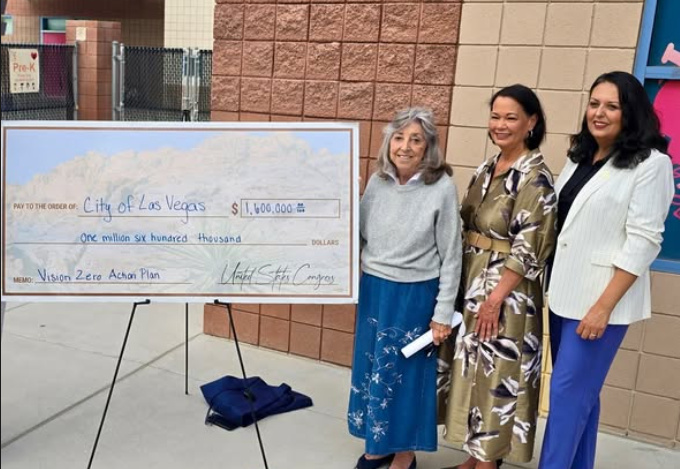
Rep. Dina Titus announced the funding in a late-August social media post, saying the money would support the City of Las Vegas’ Vision Zero School Zone project. The announcement displayed a ceremonial check for $1.6 million and highlighted Titus’ work on transportation safety in Congress.
A Las Vegas News review of federal appropriations records confirms the $1.6 million total and provides additional context about how the funding was assembled. The money appears in two separate fiscal 2026 transportation appropriations for the same Vision Zero School Zone Safety Improvements project: $1.1 million through the Highway Infrastructure Programs account and $500,000 through the Transit Infrastructure Grants account.
Where the $1.6 million comes from
The larger $1.1 million allocation is listed in the Congressional Record for the Vision Zero School Zone Safety Improvements project. Federal records identify Rep. Susie Lee and Titus as House requesters, with Sens. Catherine Cortez Masto and Jacky Rosen listed on the Senate side.
A second $500,000 appropriation for the City of Las Vegas project appears under Transit Infrastructure Grants. Rep. Steven Horsford is listed as the House requester, with Cortez Masto and Rosen again listed as Senate requesters.
| Federal account | Amount | Congressional records list |
|---|---|---|
| Highway Infrastructure Programs | $1.1 million | House: Susie Lee, Dina Titus; Senate: Catherine Cortez Masto, Jacky Rosen |
| Transit Infrastructure Grants | $500,000 | House: Steven Horsford; Senate: Catherine Cortez Masto, Jacky Rosen |
| Total designated for the project | $1.6 million | City of Las Vegas Vision Zero School Zone Safety Improvements |
The funding was included in the Consolidated Appropriations Act, 2026, Public Law 119-75, which was approved Feb. 3, 2026. A subsequent Federal Highway Administration allocation memo specifically lists the $1.1 million Vision Zero project as Nevada project NV136 and shows the full amount available under the law.
What the school-zone project is designed to do
In a May 2025 congressional funding disclosure, Titus said the project was intended to implement transportation-safety enhancements at 281 school-zone locations throughout Las Vegas. The funding request said the work would support the city’s Vision Zero Action Plan and improve the operation and maintenance of school-zone flasher systems.
Other congressional project descriptions provide more detail. Lee’s office said the proposed improvements include new visual alert systems, ancillary signage and pavement markings. Horsford’s funding request said the project would also include federally adopted safety countermeasures such as improved crosswalk visibility.
Horsford’s office identified Howard Heckethorn Elementary School, Lied Middle School and Bonanza High School among the schools expected to benefit in Nevada’s 4th Congressional District, along with more than 45 other schools in that district.
Why Las Vegas is targeting school-zone safety
The funding arrives as Las Vegas continues to expand its broader Vision Zero program. In a February 2026 update, the city reported 53,596 transportation crashes from 2018 through 2022, resulting in 251 deaths and 750 serious injuries. Nearly half of those killed were pedestrians, bicyclists or motorcyclists, according to the city.
The same update said Las Vegas has secured more than $45 million for transportation-safety work since launching Vision Zero in 2022. Through its Safe Routes to School program, the city said 22 schools had been prioritized for walk audits and safety assessments, producing 733 identified safety improvements.
The city’s updated Vision Zero Action Plan is built around the premise that roadway deaths and serious injuries can be reduced through safer street design, lower-risk speeds, better traffic operations and stronger protections for vulnerable road users.
Las Vegas’ own project materials underscore the school-zone risk. Titus’ disclosure states that nearly one-quarter of city school zones are located along High Injury Network corridors, where fatal and serious crashes are concentrated.
School safety efforts extend beyond the federal grant
The Vision Zero school-zone investment is one part of a larger city strategy. In July, Las Vegas announced that crossing guards would be added at five more high schools for the 2026-27 school year: Bonanza, Centennial, Desert Pines, Shadow Ridge and Western.
Those schools joined Arbor View, Cimarron-Memorial, Clark and Palo Verde high schools. The city said all elementary and middle schools within the city already had crossing guards assigned, bringing the total number of schools served by crossing guards to 92. Las Vegas said it spends about $3.59 million annually on 322 crossing guards.
The city also approved a separate traffic-safety analytics pilot in 2026 using radar and camera technology at 12 locations to collect data on speeding, red-light running and behavior around high-injury intersections, construction areas and school zones. That pilot is intended to help city engineers determine where additional safety treatments may be warranted.
What happens next
Federal documents establish the funding amounts and broad purposes of the Vision Zero School Zone Safety Improvements project, but the sources reviewed by Las Vegas News do not provide a complete public construction schedule for all 281 locations.
That means several implementation details remain important for families and motorists: which locations will be upgraded first, when construction will begin, how long citywide installation will take and whether particular sites will receive only flasher-system upgrades or a broader package of crosswalk, signage and pavement improvements.
As those details are released, the project is expected to become one of the more visible components of Las Vegas’ Vision Zero strategy because school-zone infrastructure operates at the point where daily vehicle traffic intersects with children walking, biking and being dropped off or picked up from school.
For families, the practical test will be whether the federal investment produces clearer warnings, more reliable flashing systems, more visible crossings and safer driver behavior around schools — particularly along the corridors where the city’s own crash data shows the greatest risk.
Sources and documents
- Office of Rep. Dina Titus — FY2026 Vision Zero School Zone Safety Improvements disclosure
- U.S. Government Publishing Office — Congressional Record, Jan. 20, 2026
- Federal Highway Administration — FY2026 Highway Infrastructure Program project allocation memo
- U.S. Senate Committee on Appropriations — FY2026 Transportation-HUD Congressionally Directed Spending
- Office of Rep. Steven Horsford — FY2026 Nevada transportation funding
- Office of Rep. Susie Lee — Community Project Funding disclosure
- City of Las Vegas — 2026 Vision Zero Action Plan update
- City of Las Vegas — 2026-27 crossing guard expansion
- U.S. Government Publishing Office — Public Law 119-75, Consolidated Appropriations Act, 2026
Reporting note: Las Vegas News reviewed congressional funding disclosures, the Congressional Record, federal transportation allocation documents and City of Las Vegas Vision Zero materials. The $1.6 million total is supported by two separately listed fiscal 2026 appropriations for the same school-zone safety project.