
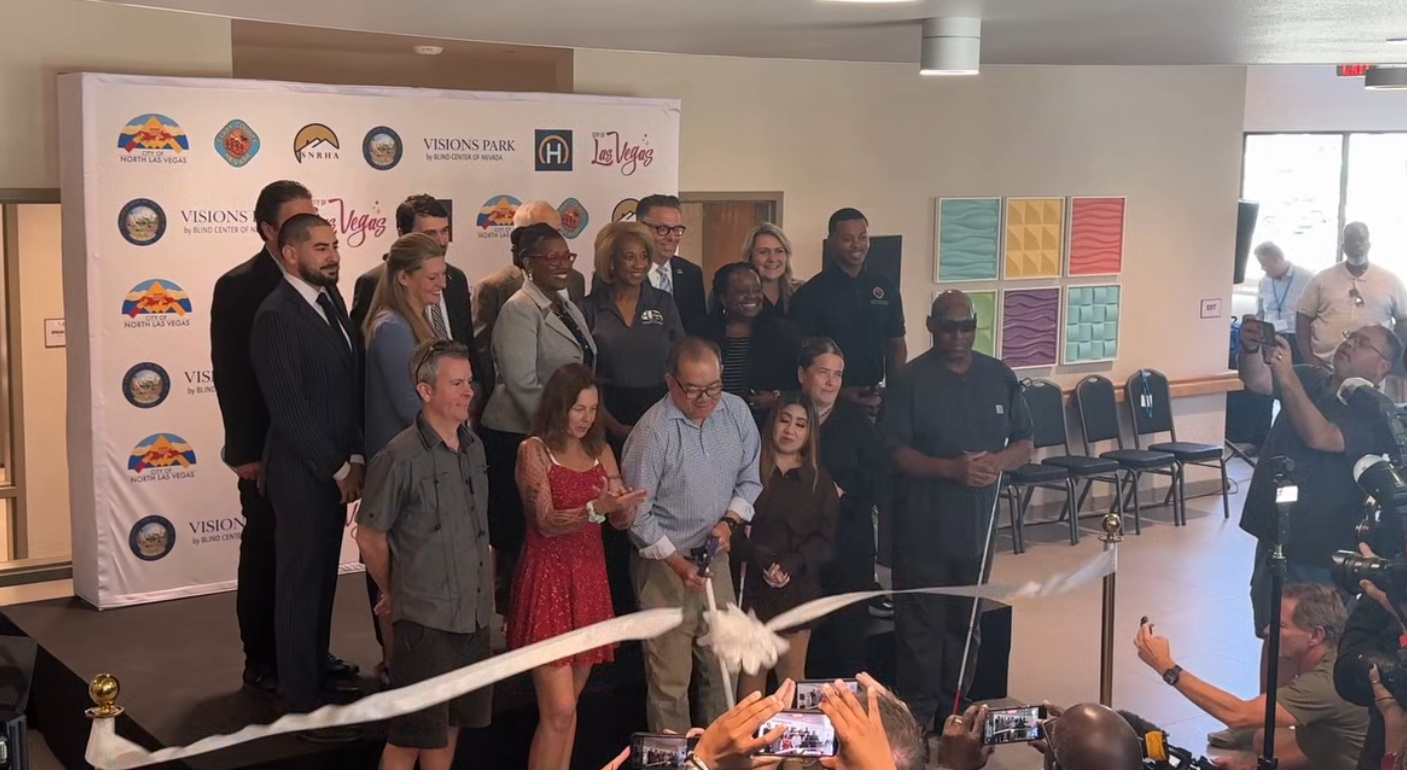
LAS VEGAS — Visions Park, an affordable apartment community built specifically around the daily needs of people who are blind or have low vision, formally opened near downtown Las Vegas on Thursday, Aug. 27, bringing 99 accessible homes and a network of optional support services to the Blind Center of Nevada campus.
The ribbon cutting marked the completion of a roughly $40 million regional housing project at 950 Visions Park Lane. The three-story development includes fully furnished one-, two- and three-bedroom apartments, in-unit washers and dryers, accessible fixtures and design elements intended to make independent navigation safer and easier.

Housing designed for independent navigation
Visions Park is not simply a conventional apartment building with a limited number of modified units. According to the project’s current leasing materials, every apartment and common area was planned with accessibility in mind. Features include specialized lighting for people with different degrees of vision loss; wide doorways; roll-in showers; reachable controls; Braille identifiers; and walkways and flooring that provide tactile and audible cues.
The homes are furnished, reducing an additional move-in expense for residents. Local reporting before the grand opening found that a private donor provided about $1 million to furnish the apartments with beds, desks, televisions and other household essentials.
The location is also a central part of the design. Visions Park sits next to the Blind Center of Nevada at 1001 N. Bruce Street, giving residents walkable access to orientation and mobility instruction, vocational rehabilitation, job training, daily lunches, a food pantry, adaptive-technology resources and community programs.
Optional services listed for residents include an AI learning lab, a mental-health navigator program developed with a UNLV practice, peer mentoring, an on-demand navigator service and programs intended to support employment and independent living. The Blind Center says those services are available at no additional cost to residents.
“We are creating a model for what inclusive housing can look like across the country.” — Todd Imholte, president and CEO of the Blind Center of Nevada, in an April 2026 statement
Regional public funding helped build Visions Park
The development is the product of an unusually broad Southern Nevada funding partnership. Project materials identify the Nevada Housing Division’s Home Means Nevada initiative, Clark County, three valley cities, the Southern Nevada Regional Housing Authority, the Federal Home Loan Bank of San Francisco and private donors among its supporters.
| Funding source | Reported contribution |
|---|---|
| State of Nevada — Home Means Nevada | $15 million |
| Clark County | $8 million |
| City of Las Vegas — American Rescue Plan Act recovery funds | $4 million |
| City of Henderson | $1.5 million |
| City of North Las Vegas | $1.5 million |
| Federal Home Loan Bank of San Francisco | More than $1 million |
Clark County said it contributed $8 million in Community Housing Funds and that Commissioner William McCurdy II represented the county at the ribbon cutting. The city of Las Vegas said its $4 million grant came from State and Local Fiscal Recovery Funds created by the American Rescue Plan Act of 2021 and supported initial design and construction costs.
Earlier project reporting identified $15 million from Home Means Nevada, $1.5 million each from Henderson and North Las Vegas, and more than $1 million from the Federal Home Loan Bank. The official Visions Park site also lists charitable donors and a sustainability endowment. Those identified amounts are components of the overall $40 million project and should not be read as an exhaustive line-by-line financing statement.
Who qualifies for a Visions Park apartment?
Visions Park’s current eligibility page says all units are restricted to households at 30% or 40% of the Clark County area median income. The project gives waiting-list preference to households in which at least one member is legally blind or visually impaired and to households that can benefit from the optional supportive services.
Applicants must have at least one household member with a qualifying disability and meet the applicable income limit. The property also conducts standard credit, rental-history and criminal-history screening, and a security deposit is required upon approval. The official page says there is no minimum income to submit an application.
For 2026, Visions Park lists maximum qualifying incomes ranging from $22,200 at the 30% threshold for a one-person household to $41,560 at the 40% threshold for a four-person household. Limits vary by household size and program, so prospective applicants should verify the current figure directly with the property manager rather than relying on a general online calculation.
51 apartments carry project-based rental assistance
Of the 99 apartments, 51 are tied to project-based vouchers through the Southern Nevada Regional Housing Authority. Unlike a tenant-based housing voucher that a household may use with a participating private landlord, project-based assistance remains connected to a designated apartment development. The remaining 48 Visions Park homes are offered at restricted, reduced affordable rents, according to the development’s website.
The distinction matters to applicants because rent calculations, paperwork and availability may differ between the two programs. Visions Park directs applicants to contact its management team for current rents and to determine which program may fit their household.
Why the location matters
Before the project was built, the Blind Center said many members spent one to two hours traveling each way to reach training, meals and other services. The organization also reported that more than 90% of its members were living below the extremely low-income level, leaving many with few safe and affordable housing choices.
Placing deeply affordable housing beside the Blind Center shortens that trip and connects residents to services without requiring them to cross the Las Vegas Valley for routine support. It also pairs housing with voluntary assistance rather than making residents choose between an affordable apartment and access to the programs they use.
The community began welcoming its first residents before the formal grand opening. By late July, local reporting documented initial move-ins, while the Aug. 27 ceremony brought residents, the Blind Center and representatives of the governments and organizations that financed the project together at the completed property.
Sources and reporting notes
Las Vegas News reviewed the official Visions Park project and eligibility site, the Blind Center of Nevada’s housing overview, application information from Accessible Space Inc., funding statements from U.S. Sen. Catherine Cortez Masto and the city of Las Vegas, Clark County’s ribbon-cutting announcement, and contemporaneous local reporting from KSNV and KVVU. Application details were current as of publication.