

Las Vegas Business Leaders | Executive Profile
They Called Neonopolis a Failure. Rohit Joshi Never Walked Away.
From an immigrant student teaching music in Ohio to a decades-long career in commercial real estate and the reinvention of one of Downtown Las Vegas’ most visible properties, Rohit Joshi’s story is about persistence, adaptation and a belief that successful development ultimately depends on people.
LAS VEGAS — Rohit Joshi has spent much of his career making bets on businesses, places and people before the outcome was certain.
Long before his name became closely tied to Neonopolis at Fremont Street and Las Vegas Boulevard, Joshi says he was a young student from India trying to make his way in Ohio, teaching music while completing his education and learning American business from the inside.
He eventually bought the music store where he worked.
Decades later, the size of the wager had changed dramatically. Instead of a small retail business, Joshi found himself attached to a roughly 250,000-square-foot Downtown Las Vegas complex that had already frustrated investors, disappointed city leaders and struggled to find a lasting identity.
He stayed.
That decision may explain Rohit Joshi better than any résumé.
Rohit Joshi at a Glance
Why Rohit Joshi Matters to Las Vegas
- He became one of the most persistent private-sector figures associated with the long redevelopment of Neonopolis.
- He helped shift the property away from a conventional mall strategy toward dining, nightlife and experience-driven entertainment.
- His development career predates his Las Vegas chapter by decades, with independent reporting documenting large commercial projects as early as 1992.
- The City of Las Vegas later featured “Rohit Joshi of Neonopolis” among Downtown Las Vegas influencers in its 2024 “Down for Anything” campaign.
From Bombay to Ohio: learning business from the ground up
Joshi’s company biography says he attended St. Xavier’s Boys Academy and St. Xavier’s College in Bombay, now Mumbai, before leaving India for the United States in 1964. He continued his education at the University of Akron in Ohio, where the biography says he earned a bachelor’s degree in economics and a master’s degree in business administration.
With limited financial support, according to the same account, Joshi turned to music. He began teaching at a local music store, learned the rhythms of American commerce and eventually obtained financing to buy the store himself.
The move from employee to owner became an early expression of a pattern that would follow him: understand a business from the inside, take responsibility for it and then look for ways to expand what it could become.
A 2013 Las Vegas Sun column, recounting Joshi’s biography, said he met prominent mall developer and San Francisco 49ers owner Edward DeBartolo in 1973. The account says DeBartolo encouraged Joshi to put his R.J. Music operation into shopping malls, leading to 11 stores in DeBartolo properties on the East Coast.
A career built before Las Vegas
Joshi’s own materials describe decades of work involving shopping centers, leasing, financing, zoning, construction, redevelopment and major retailers. The company says it has worked with or represented national retail names and participated in international development. Las Vegas News has not independently verified the full scope of every corporate or international claim, so those assertions are treated as company-reported background rather than independent fact.
There is, however, strong independent evidence that Joshi was pursuing large commercial projects years before his Las Vegas chapter.
On Jan. 31, 1992, the Daily News reported that Joshi, identified as the owner of R.J. Development Co., was negotiating to acquire 129 acres at Westlake North from the federal Resolution Trust Corp. The potential price was reported at between $30 million and $60 million. The property was tied to plans that had included major retail, restaurants, offices, a hotel, condominiums and public improvements.
The article also placed Joshi directly in the familiar tension between developer ambition and community expectations. Residents were concerned about traffic and the scale of development; Joshi said his likely plan would change portions of the earlier proposal in response to market conditions.
That history is significant because it establishes Joshi as more than the operator of one difficult Las Vegas property. He had already spent years working where land, financing, government approvals, tenant needs and community concerns intersect.
What the record establishes — and what remains company-reported
- Independently documented: Joshi was pursuing a major Westlake Village development in 1992; his group acquired Neonopolis for $25 million in 2006; by 2009, contemporary reporting placed the group’s total investment at at least $40 million; and Las Vegas reporting documents his subsequent entertainment-focused repositioning of the property.
- Company-reported: portions of Joshi’s education and early personal history, the full scale of his national retail relationships, and claims involving international projects in China and Hong Kong.
The businessman who preferred the background
When Joshi first appeared regularly in Las Vegas coverage, he was not generally portrayed as someone seeking celebrity.
In December 2004, while the future of Neonopolis was uncertain, the Las Vegas Sun described Joshi as a “behind-the-scenes operator” who rarely sought public attention. The same report connected him to efforts involving Touro University and the Las Vegas 51s baseball team.
That description is notable in hindsight. Two decades later, the City of Las Vegas would put his name and face into a public campaign celebrating Downtown entrepreneurs and influencers.
The path between those moments runs directly through one of Downtown Las Vegas’ most difficult commercial properties.
The years that tested the bet
Neonopolis opened in 2002 with a premier location and major expectations. Yet the project struggled to perform like the conventional mall originally envisioned.
Joshi’s investment group, Wirrulla Hayward, paid $25 million for the 250,000-square-foot complex in 2006. By 2009, Vegas Inc. reported that the ownership group’s total investment had reached at least $40 million.
The problems during the early ownership years were substantial: vacancies, tenant turnover, building issues, public skepticism and an increasingly difficult retail model. In 2007, then-Mayor Oscar Goodman publicly called the property a “blight” while city officials expressed frustration about the pace of progress. Contemporary reporting also documented ambitious ideas that did not reach their promised form, including an attempted revival of Star Trek: The Experience.
The difficult history is not incidental to Joshi’s profile. It is what makes the later transformation meaningful. He did not inherit a functioning destination and simply maintain it. He became associated with a property that had already developed a reputation for failure.
The strategic decision that changed Neonopolis
By 2012, Joshi was saying publicly what years of leasing struggles had made clear: the property could not depend on a traditional retail-mall formula.
“When we figured out retail wasn’t going to work, we started looking at entertainment models,” Joshi told Vegas Inc..
That pivot changed the logic of Neonopolis.
Instead of relying on conventional retail anchors, the property increasingly sought businesses built around experience — bowling, nightlife, unusual restaurants, karaoke, weddings, gaming, live performance, axe throwing and other concepts that could give visitors a reason to enter, stay and return.

The Nerd later combined gaming, bowling and nightlife. Notoriety turned former cinema space into live-performance rooms. Cat’s Meow brought karaoke to the second level. Gene Woods Racing Experience and Axehole added activity-based attractions. Wedding chapels, bars and dining concepts further diversified the building.
The shift also aligned Neonopolis more closely with what Downtown Las Vegas itself was becoming: less dependent on traditional shopping and increasingly built around food, nightlife, entertainment and memorable experiences.
The people behind the leases
One sentence in Joshi’s biography provides a useful window into how he describes his own business philosophy: “each business represents a person and usually a family.”
That is a statement of philosophy, not an independent verdict on every landlord-tenant relationship he has managed. But it helps explain why a property once conceived as a shopping center gradually became home to an eclectic collection of independently operated and unconventional businesses.
The official Neonopolis profile of Joshi describes him as a hands-on facilitator and recounts stories of working with struggling tenants rather than treating the lease as the end of the relationship. That material is published by the property itself and is therefore best understood as Neonopolis’ account of his management style. Still, it is consistent with a broader strategy that depends heavily on individual operators willing to take risks.

Neonopolis’ current website divides the complex into three broad districts: food and beverage on the main floor, nightlife on the second floor and entertainment on the top floor. The property’s current directory lists a mix of shops, restaurants, bars, performance venues, chapels and attractions.
That structure is fundamentally different from the model that struggled during the building’s earliest years.
A 2026 snapshot: 22 businesses and a property still changing
As of September 2026, Neonopolis’ official website advertises 22 businesses. Its current directory includes dining names such as The Hush Puppy, Dirt Dog, Denny’s, Fat Sal’s, Fat Tuesday and Swirl Twirl; nightlife and restaurant concepts including Cat’s Meow, The Nerd, Raised By Wolves, Substance and Alebrijes by Chef Paco; entertainment such as Axehole, Gene Woods Racing Experience and Notoriety; and specialty retail including Toy Shack, Fremont Watches and sports-card and tattoo businesses.
That roster also provides a current example of Joshi’s long-running strategy: the mix keeps changing.

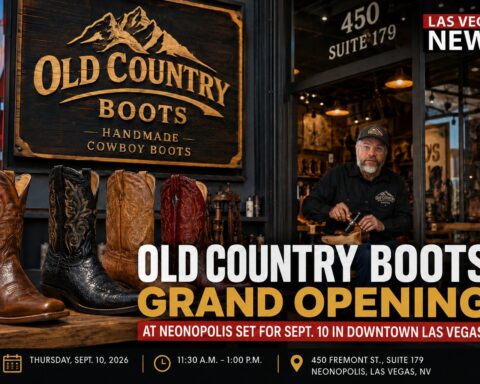
Fat Sal’s, the Los Angeles-born sandwich brand, currently lists its Las Vegas location as open inside Neonopolis at 450 Fremont Street. The property’s own directory also lists the restaurant as a current tenant.
Another recent addition illustrates how quickly the roster can evolve. In April 2026, local development reporting identified a permit for Swirl Twirl Soft Serve & Taiyaki at Neonopolis. By September, Neonopolis had added Swirl Twirl to its official tenant directory and published a dedicated page for the dessert concept.

The opening is a small detail in a much larger career, but it captures the operating reality of a redevelopment project that has lasted for decades: there is no final tenant lineup. New businesses replace old concepts, existing businesses adapt and the building keeps being reprogrammed around the market in front of it.
One tenant arrives, another leaves
Late 2025 brought another example of that cycle when The Hush Puppy, a Las Vegas restaurant with roots dating to 1975, opened a second location at Neonopolis. Las Vegas Weekly reported that Joshi viewed the Southern restaurant as a cuisine the property did not already have and said the project required roughly a year of approvals and construction.
Then, in May 2026, one of Neonopolis’ most recognizable long-running tenants left. Heart Attack Grill closed after choosing not to renew its lease. Joshi confirmed the closure to FOX5, pointing to weaker tourism conditions and high operating expenses as part of the changed Las Vegas environment.

That juxtaposition — a nearly half-century-old Las Vegas restaurant expanding while another famous tenant departs — may be one of the clearest illustrations of what Joshi’s business actually requires.
Commercial development is not a finished monument. It is a living portfolio of leases, customer habits, financing decisions, construction schedules, tourism patterns and entrepreneurs deciding whether a location still works for them.
From public skepticism to City Hall recognition
One of the most striking reversals in Joshi’s Las Vegas story came not through a lease but through public recognition.
In January 2024, the City of Las Vegas announced a new phase of its “Down for Anything” campaign, designed to promote Downtown Las Vegas as a place to visit, live and do business. The city added 16 Downtown residents and influencers to the campaign.
Among them was “Rohit Joshi of Neonopolis.”
The city placed him alongside other Downtown entrepreneurs, developers, restaurant operators and community figures — a notable turn for a man whose property had once been publicly criticized by City Hall and who had been described in earlier reporting as someone who preferred operating behind the scenes.
The designation does not erase Neonopolis’ difficult years. It makes the arc more interesting. The same property that once symbolized downtown redevelopment frustration had become part of the city’s contemporary promotional identity.
What Rohit Joshi’s career says about leadership
Business profiles are often written as sequences of wins. Joshi’s record suggests something less glamorous and more useful: leadership can also mean staying close to a difficult asset long enough to understand what it needs to become.
His career spans radically different eras of American retail — from music stores inside traditional malls to a time when consumers increasingly expect destinations to offer experiences that cannot be replicated online.
Neonopolis reflects that evolution.
The property did not become what its earliest planners expected. Joshi eventually stopped trying to force it into that model.
Instead, the building was reorganized around a different proposition: food on one level, nightlife on another, entertainment above, and a rotating collection of entrepreneurs trying concepts that fit the distinctive economics and energy of Fremont Street.
From the background to a larger Las Vegas legacy
There is an unusual symmetry in Rohit Joshi’s career.
He began, according to his biography, as a young immigrant learning American business inside a music store. He moved from employee to owner, from retailer to developer, and eventually from shopping-center development to the long rehabilitation of a property that had become a public symbol of Downtown Las Vegas’ growing pains.
Along the way, the man once described as a behind-the-scenes operator became increasingly visible through the businesses, entrepreneurs and entertainment concepts gathered around Neonopolis.
That may be the most durable part of his profile.
Buildings matter. Deals matter. Capital matters. But commercial districts are ultimately experienced through the people who take risks inside them — restaurateurs, performers, operators, retailers and founders trying to turn a lease into a livelihood.
Joshi’s company says businesses represent people and families. More than half a century after he says he first learned business by teaching music and buying the store where he worked, that idea still appears to sit at the center of how he presents his approach to development.
His Las Vegas story is therefore larger than Neonopolis alone.
It is a case study in what long-term developers can do when they continue adjusting a property after the original thesis fails — deciding which concepts deserve another chance, which entrepreneurs fit the next version of the building and which corners of a city remain worth fighting to reinvent.
Neonopolis remains unfinished in the best Las Vegas sense of the word. Businesses will open. Others will close. Concepts will be proposed, adjusted or abandoned. Downtown itself will continue changing.
And after nearly two decades tied to one of its most recognizable corners, Rohit Joshi is still making his bet — not only on the building, but on the people willing to build something inside it.
About Las Vegas Business Leaders
Las Vegas Business Leaders is an editorial profile series from Las Vegas News examining the entrepreneurs, executives, developers, innovators and organization leaders whose decisions are shaping Las Vegas and Southern Nevada. Profiles focus on the person behind the title — including the risks, setbacks, ideas and leadership choices that help explain their impact.
Key reporting sources
- Joshi & Associates — Rohit Joshi biography
- Daily News / City of Westlake Village archive — Jan. 31, 1992 development report
- Las Vegas Sun — Neonopolis sale reporting, 2004
- Las Vegas Review-Journal report syndicated by Casino City Times — City criticism and rebranding effort, 2007
- Vegas Inc. — acquisition and investment reporting, 2009
- Vegas Inc. — entertainment-strategy pivot, 2012
- City of Las Vegas — “Down for Anything” campaign, 2024
- Neonopolis — current 2026 tenant directory and property information
- Neonopolis — Swirl Twirl current tenant page
- Fat Sal’s — current Las Vegas/Neonopolis location listing
- Las Vegas Weekly — The Hush Puppy expansion, 2025
- FOX5 — Heart Attack Grill closure, 2026
Help other readers find trusted local news
A short review helps Las Vegas readers discover fact-based reporting and supports independent local journalism.