

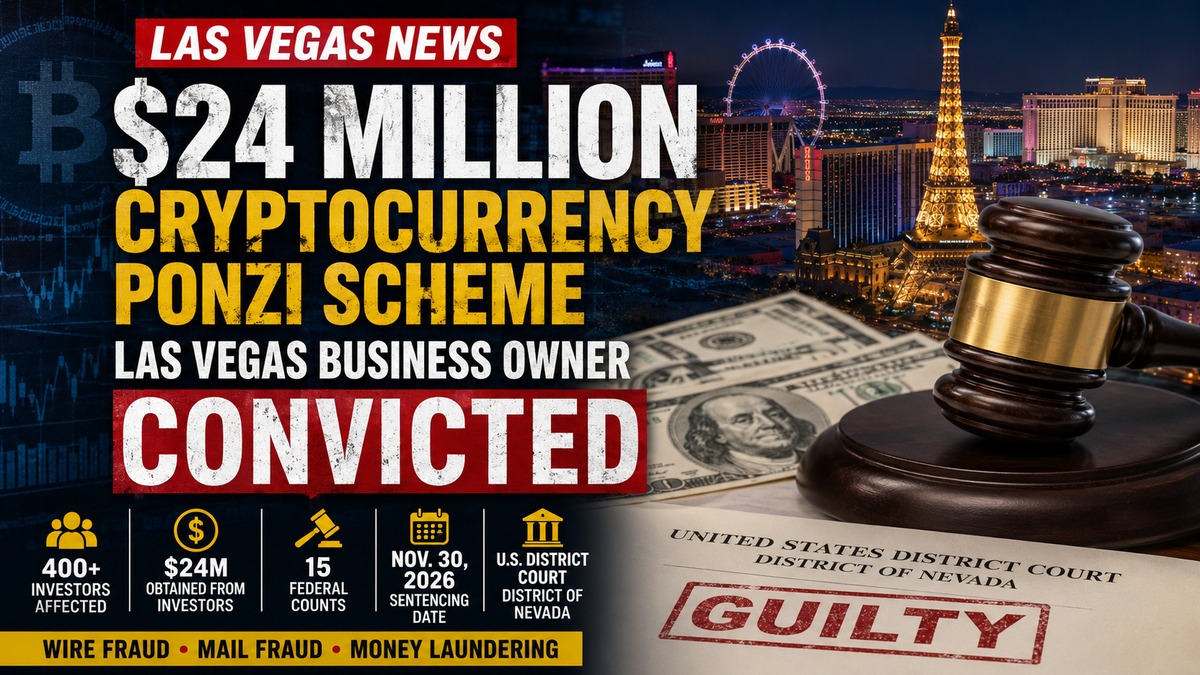
Las Vegas Business Owner Convicted in $24 Million Cryptocurrency Ponzi Scheme
A federal jury found Brent C. Kovar guilty on 15 fraud and money-laundering counts after prosecutors said his Las Vegas-based Profit Connect operation used claims about artificial intelligence, cryptocurrency mining and guaranteed returns to obtain $24 million from at least 400 investors.
At a glance
- Defendant: Brent C. Kovar
- Company: Profit Connect
- Investor money: Approximately $24 million
- Investors: At least 400
- Verdict: Guilty on 15 federal counts
- Criminal case: United States v. Kovar, 2:25-cr-00028-JAD-MDC
- Sentencing: Nov. 30, 2026
LAS VEGAS — A federal jury has convicted Las Vegas business owner Brent C. Kovar of operating a multimillion-dollar investment scheme that prosecutors said used promises of artificial intelligence, cryptocurrency mining and guaranteed investment returns to obtain approximately $24 million from hundreds of investors.
Kovar, owner of Las Vegas-based Profit Connect, was convicted Monday following a nine-day trial of 11 counts of wire fraud, two counts of mail fraud and two counts of money laundering, according to the U.S. Attorney’s Office for the District of Nevada.
Prosecutors said Kovar fraudulently obtained approximately $24 million from at least 400 investors.
U.S. District Court for the District of Nevada
What the jury found
The conviction changes the legal posture of the Profit Connect story significantly.
When federal authorities first charged Kovar in February 2025, the government’s assertions were allegations and Kovar was presumed innocent. Following the August 2026 trial, a federal jury found him guilty beyond a reasonable doubt on 15 criminal counts.
According to prosecutors, Kovar owned Profit Connect from late 2017 through July 2021 and represented that the company used artificial-intelligence software operating on a supercomputer to mine cryptocurrency and verify cryptocurrency transactions.
Prosecutors said investors were promised fixed annual returns ranging from approximately 15% to 30%, along with a 100% money-back guarantee.
Kovar also represented that Profit Connect was backed by hundreds of millions of dollars in cryptocurrency reserves, the Justice Department said.
The jury’s verdict followed evidence presented by federal prosecutors that Profit Connect was not profitable, lacked the claimed reserves and had no legitimate means to produce either the advertised fixed returns or the promised guarantee.
How prosecutors said the scheme worked
SEC shut down Profit Connect years before the criminal conviction
The criminal prosecution followed a separate federal securities case that began approximately five years before the jury verdict.
In July 2021, the U.S. Securities and Exchange Commission obtained emergency relief against Profit Connect Wealth Services Inc., Brent Kovar and Joy I. Kovar.
At the time, the SEC said the company had raised more than $12 million from at least 277 retail investors.
The agency alleged that investors were told their money would be placed in securities, bitcoin and other cryptocurrencies based on recommendations generated by an artificial-intelligence supercomputer.
The SEC further alleged that more than 90% of the company’s funds came from investors, rather than investment profits.
Criminal investigation ultimately identified twice as much investor money
The scope identified in the completed criminal case was considerably larger than what regulators publicly disclosed when they intervened in 2021.
The SEC initially identified more than $12 million raised from at least 277 investors. Federal prosecutors said after trial that Kovar obtained approximately $24 million from at least 400 investors.
That does not necessarily mean investors collectively suffered a final net loss of exactly $24 million.
Gross money obtained, money returned to investors, assets recovered through the receivership and restitution calculations can produce different figures. A final restitution determination may be addressed as part of Kovar’s sentencing proceedings.
Investors were allegedly encouraged to use retirement and home-equity money
The SEC’s earlier civil case provided additional details about how Profit Connect was marketed.
Regulators alleged that the operation targeted people looking for investments associated with retirement and education and that prospective investors were encouraged to consider funds from retirement accounts and home equity.
Profit Connect also marketed returns while presenting investors with assurances of limited risk through its purported money-back guarantee, according to the SEC.
Investigators say Kovar falsely invoked FDIC protection
Federal investigators also said some investors were led to believe their investments were protected by the Federal Deposit Insurance Corporation.
Ryan Korner, special agent in charge with the FDIC Office of Inspector General, said following the verdict that Kovar had lured investors with false claims that his investment was insured by the FDIC.
FDIC insurance generally covers qualifying deposits at insured banking institutions. It does not provide blanket federal insurance for private cryptocurrency investments or investment programs.
Kovar’s criminal case began with an 18-count indictment
A federal grand jury indicted Kovar on Feb. 12, 2025.
The Justice Department’s original indictment announcement said Kovar was charged with 12 counts of wire fraud, three counts of mail fraud and three counts of money laundering.
The government alleged that Kovar used a website, YouTube video and PowerPoint presentation to market the investment operation and leased both sales-office space and warehouse space for a purported data center.
Court records identify the criminal proceeding as United States v. Brent C. Kovar, Case No. 2:25-cr-00028-JAD-MDC in the U.S. District Court for the District of Nevada.
Profit Connect receivership is still pursuing investor money
The collapse of Profit Connect also resulted in a court-supervised receivership that continues to matter for investors seeking recovery.
Geoff Winkler of American Fiduciary Services was appointed permanent receiver over Profit Connect in August 2021. The appointment gave the receiver broad authority to investigate assets and pursue claims for the benefit of the receivership estate.
Federal court records show that recovery litigation was still active in 2026.
In a separate case filed by Winkler against former Profit Connect promoters, the receiver alleged that investor funds were distributed to the company’s founders and promoters and sought to recover certain transfers under Nevada law.
That litigation is identified as Winkler v. Thompson et al., Case No. 2:25-cv-01522-JCM-DJA.
An April 10, 2026 federal court order confirms that the recovery litigation remained active months before Kovar’s criminal conviction.
Bank of America settlement added money to the recovery process
The Profit Connect receivership also pursued claims involving financial institutions.
Court records show that the receiver reached a $1.825 million settlement with Bank of America.
U.S. District Judge Jennifer A. Dorsey preliminarily approved that settlement in June 2025, subject to the court’s settlement-approval process.
Under the agreement, the settlement money was intended for the receivership estate and eligible non-opt-out receivership claimants after approved fees and expenses.
The settlement did not constitute an admission of wrongdoing by Bank of America and was separate from the government’s criminal prosecution of Kovar.
A separate 2026 ruling shows recovery efforts remain active
The continuing receivership litigation adds a significant post-verdict issue for Profit Connect investors: obtaining a criminal conviction does not itself return all investor money.
In January 2026, a Nevada federal judge allowed significant portions of the receiver’s claims against several alleged Profit Connect promoters to continue.
In April, the court issued another substantive ruling in the same proceeding involving summary-judgment motions.
The receiver has alleged that certain promoters received funds originally obtained from Profit Connect investors and has sought recovery under fraudulent-transfer and unjust-enrichment theories.
Those claims are separate civil matters and allegations against individual defendants should not be interpreted as criminal convictions.
Profit Connect case timeline
What happens next in federal court
Kovar is scheduled to be sentenced Nov. 30, 2026.
The Justice Department said the offenses of conviction carry a combined statutory maximum of 280 years in federal prison.
Kovar originally faced a maximum statutory exposure of 330 years under the 18-count indictment. His post-trial exposure cited by prosecutors is lower because the jury convicted him on 15 counts.
Sentencing proceedings may also provide additional information about victim losses, restitution and other financial consequences arising from the case.
Federal investigators warn about guaranteed investment returns
The Profit Connect prosecution reflects a longstanding warning from financial regulators and law-enforcement agencies: high or guaranteed investment returns combined with assertions of little or no risk can be significant fraud indicators.
The technology involved in an investment pitch does not eliminate that risk.
Profit Connect’s marketing incorporated concepts that attracted considerable investor attention — artificial intelligence, cryptocurrency, blockchain-related transactions and supercomputing.
Prosecutors said those claims ultimately concealed a fundamental problem: Profit Connect did not possess the profits or reserves it represented to investors.
The FBI says people who believe they have information concerning fraud or believe they may have been victimized can report information through the FBI’s Internet Crime Complaint Center.
Who investigated the case
The criminal investigation was conducted by IRS Criminal Investigation, the FBI and the FDIC Office of Inspector General.
Assistant U.S. Attorneys Joshua Brister and James Gaeta prosecuted the trial, according to the Justice Department’s Aug. 24 announcement.
Sources and court records
U.S. Attorney’s Office, District of Nevada — Jury conviction announcement, Aug. 24, 2026
U.S. Attorney’s Office, District of Nevada — Kovar indictment announcement
U.S. Securities and Exchange Commission — Profit Connect emergency enforcement action
Federal court records: United States v. Kovar, 2:25-cr-00028-JAD-MDC
Federal receivership litigation: SEC v. Profit Connect Wealth Services Inc. et al., 2:21-cv-01298-JAD-BNW
Receiver recovery litigation: Winkler v. Thompson et al., 2:25-cv-01522-JCM-DJA
Las Vegas News will update this report as additional court records become available and when Kovar is sentenced.