


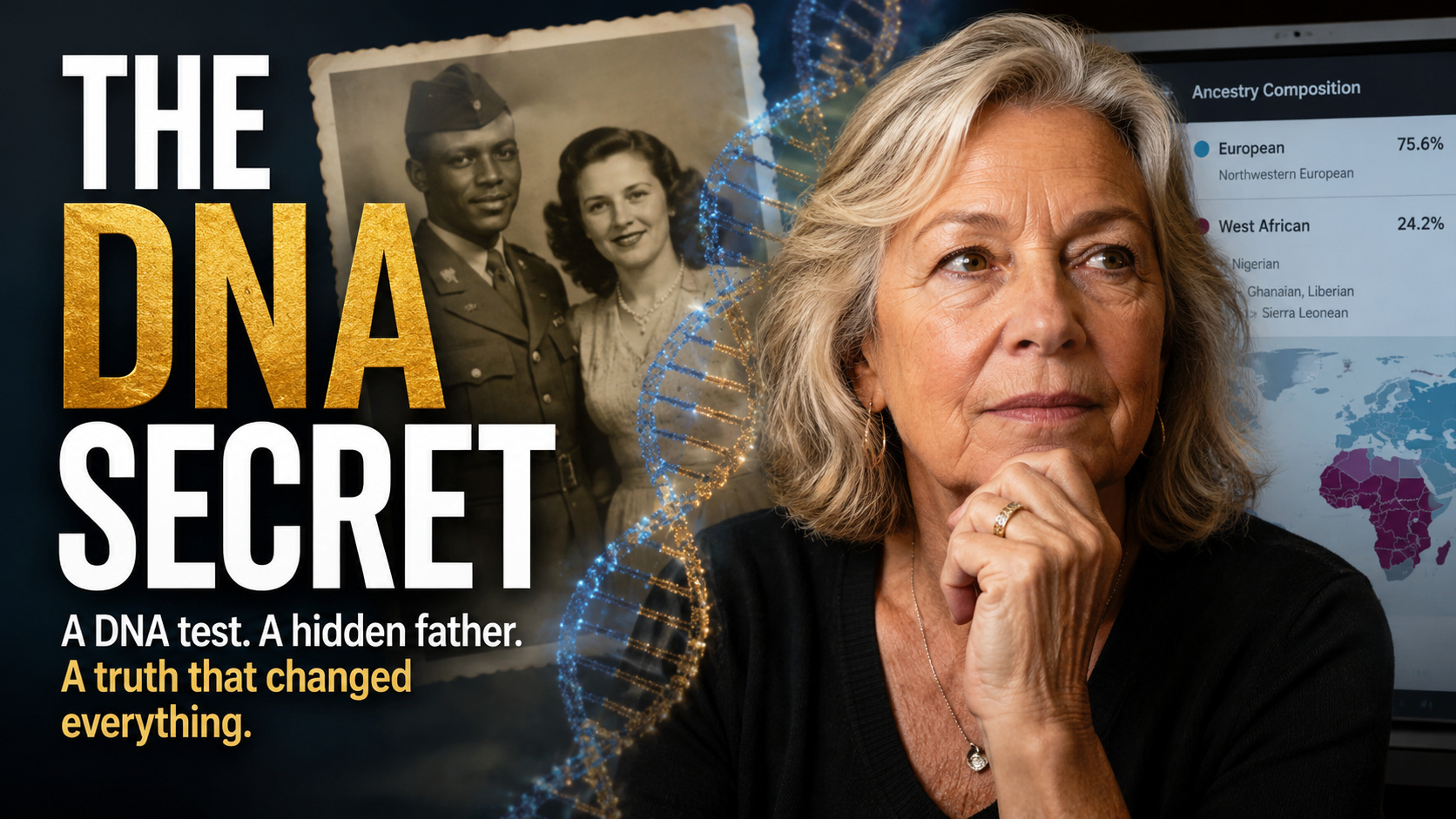
She Took a DNA Test at 64 — and Uncovered a Family Secret Hidden for Decades
Christine Jacobsen expected her ancestry results to confirm her Danish roots. Instead, they revealed West African ancestry, a probable Black biological father and a sensational story about her conception that remains impossible to prove.
At 64, Christine Jacobsen thought she knew who she was, where she came from and who her parents were.
One DNA test disrupted all three.
The results pointed toward a family she had never known, a probable Black biological father hidden from her for decades and a question no genetic test could fully answer: What had really happened before she was born?
At a glance
- Christine Jacobsen was raised by white Danish immigrant parents in New York City.
- An at-home DNA test estimated that roughly one-quarter of her ancestry came from West Africa.
- A later DNA match connected her with a woman believed to be a first cousin.
- Genealogical and biographical evidence pointed to Paul Keith Meeres as her probable biological father.
- Meeres was deceased, preventing a direct father-daughter paternity test.
- Jacobsen believes she may have been conceived through her parents’ swinging circle, but the exact circumstances have not been proven.
Christine Jacobsen believed she already knew what an ancestry test would tell her.
The two people who raised her were white immigrants from Denmark, and Jacobsen had spent most of her life understanding herself as a white woman with predominantly Danish roots.
But when she took an at-home DNA test in 2016 at age 64, the results did not match the family history she expected.
The test estimated that roughly one-quarter of her ancestry came from West Africa, according to accounts Jacobsen later gave to Business Insider and The Wall Street Journal.
The result did more than alter a pie chart on a genealogy website. It revived an explosive allegation Jacobsen had heard as a teenager and pushed her into an investigation of her biological identity.
A secret surfaced during an argument
Jacobsen has said the first warning that her family story might not be complete came decades before consumer DNA testing became widely available.
In 1968, when Jacobsen was a teenager, she became involved in an argument with a man who was having a relationship with her mother. According to Jacobsen’s recollection, the man abruptly told her that she did not know her father was Black.
Jacobsen said her mother reacted as though a promise of secrecy had been broken. Her mother subsequently showed her an old photograph and said the man pictured might be Jacobsen’s biological father—a light-skinned dancer associated with the Bahamas.
The white Danish man who had raised Jacobsen dismissed the suggestion, and the family largely stopped discussing it.
For decades, the allegation remained unresolved.
The DNA match that changed the investigation
Jacobsen’s first DNA test established that her ancestry was not exclusively European, but its initial relative matches were too distant to identify a biological father.
Two years later, she took another test through 23andMe. That service connected her with a Black woman it identified as a likely first cousin.
The two women compared the amount of DNA they shared, reconstructed a family tree and examined the men in the cousin’s family who could have been Jacobsen’s father.
Their investigation pointed to the cousin’s uncle, Paul Keith Meeres.
Meeres was already dead, which meant Jacobsen could not conduct a direct paternity comparison. The identification instead rested on the genetic relationship with his niece and a collection of biographical details that aligned with what Jacobsen remembered her mother saying.
What supported the identification
A close DNA-relative match, the reconstructed family tree, Meeres’ connection to the Bahamas, his career as a dancer and his presence in New York during the relevant period.
What remained unavailable
A direct DNA comparison between Jacobsen and Meeres, who died decades before her investigation.
What the evidence establishes
Confirmed in the reported record
- Jacobsen was raised by white Danish parents.
- Consumer DNA testing indicated substantial West African ancestry.
- A later test produced a close-relative match connected to the Meeres family.
Strongly supported
- Paul Keith Meeres was Jacobsen’s probable biological father.
- His background, occupation and location aligned with details Jacobsen remembered from her mother.
- Genealogy and the close-relative match pointed toward the same paternal family.
Not proven
- The precise date, place or circumstances of Jacobsen’s conception.
- That conception occurred during a swingers’ gathering.
- Paternity through a direct DNA comparison with Meeres.
How the family secret unfolded
During a family dispute, Jacobsen was told that the white Danish man who raised her might not be her biological father and that her father was Black.
At age 64, she took an ancestry test expecting results consistent with the Danish family history she had always known.
A second DNA service connected her with a woman predicted to be a close relative, giving Jacobsen a path into an unknown paternal family.
Family-tree research, shared DNA and biographical clues pointed toward Paul Keith Meeres as her probable biological father.
Jacobsen examined military and death records, contacted relatives and documented the discovery in interviews, essays and her memoir.
Who was Paul Keith Meeres?
Jacobsen’s research portrayed Meeres as a complicated figure whose life extended far beyond the paternity mystery.
In an essay published by Severance Magazine, Jacobsen identified Meeres as a Black Marine who served during World War II and trained at Montford Point, the segregated camp where the first Black U.S. Marines were trained.
Jacobsen wrote that she obtained military and death records, communicated with relatives who had known Meeres and researched his postwar career as a performer.
She later helped secure posthumous recognition of his service through the Montford Point Marines’ Congressional Gold Medal program.
At the same time, Jacobsen did not present Meeres as an uncomplicated hero. Her research uncovered accounts of unstable relationships, alcohol-related difficulties and children he reportedly did not raise.
That complexity became part of Jacobsen’s attempt to understand a father she had never knowingly met and a paternal family history that had been concealed from her.
Was she conceived at a swingers’ party?
This is the detail that transformed Jacobsen’s personal history into a viral headline—and the detail requiring the most caution.
Jacobsen said her parents participated in swinging during the 1950s and 1960s. She recalled being sent to relatives or neighbors while adults stayed overnight at the family home.
She said she eventually understood that some of the gatherings involved couples exchanging sexual partners. She also described her mother as having a continuing relationship with one of the participants.
According to Business Insider’s account, members of Meeres’ family and a former wife also described him as having multiple relationships and a reputation for participating in swinging during the relevant period.
Those facts make it plausible that Jacobsen’s mother and Meeres encountered each other through the same social circle.
They do not establish that conception occurred during a particular party.
No public account identifies an exact gathering, date, location or eyewitness who could confirm the circumstances. Jacobsen’s parents and Meeres were all deceased by the time the DNA investigation took place.
Why the viral headline is misleading
The most widely circulated version of the story stated that a woman raised as white learned her father was Black and that she “was conceived at a swingers’ party.”
That wording removes an important qualifier.
Business Insider’s original headline said Jacobsen was probably conceived at a swingers’ party. Later versions transformed that probability into certainty.
The altered wording also compresses a complex genealogical investigation into a simple DNA-test reveal. The consumer test did not display the name of Jacobsen’s father. It identified ancestry and relatives, after which Jacobsen and her match conducted family-tree and biographical research.
A discovery about identity, not only paternity
For Jacobsen, the revelation was not limited to learning the probable identity of her biological father.
She had lived for more than six decades as a socially white woman. Discovering substantial West African ancestry and a Black paternal family did not erase the culture in which she had been raised, but it altered how she understood her family history and her position within American racial life.
Jacobsen said the discovery caused her to think more carefully about racism, inequality and the privileges she had experienced while being perceived as white.
She also identified several people believed to be her paternal half-siblings after growing up as an only child.
Jacobsen eventually documented the experience in her memoir, Dancing Around the Truth, describing writing as a way to process the upheaval caused by the discovery.
Reader poll
Would you take a DNA test if the result could overturn what you believed about your family?
Share A, B, C or D—and your reasoning—in the comments. Please keep the discussion respectful toward people affected by unexpected-parentage discoveries.
Why this story resonates
Consumer DNA testing can answer questions about ancestry, but it can also expose previously unknown parents, siblings, relationships and family histories that other relatives believed would remain private.
Jacobsen’s experience raises a difficult question: Does a person’s right to understand their biological identity outweigh another relative’s desire to keep the past confidential?
A DNA result may establish biological relationships or point investigators toward them. It cannot fully explain every decision, relationship or circumstance that produced those connections.
Frequently asked questions
Did a DNA test directly identify Christine Jacobsen’s father?
No. The tests revealed ancestry and a close-relative match. Jacobsen and her relative then used genealogy and biographical information to identify Paul Keith Meeres as her probable biological father.
Was a direct paternity test conducted?
No. Meeres had died before Jacobsen’s investigation, making a direct father-daughter DNA comparison unavailable.
Was Jacobsen proven to have been conceived at a swingers’ party?
No. The reported family history makes the scenario plausible, but no public evidence verifies a particular gathering, date, location or conception event.
Why is Jacobsen described as having been raised white?
She was raised by white Danish parents and understood herself socially and culturally as white before learning about her paternal ancestry.
What did the DNA evidence establish?
It indicated substantial West African ancestry and connected Jacobsen with a close biological relative from the family later associated with her probable father.
The bottom line
The central account is credible and supported by several layers of evidence.
Jacobsen’s DNA tests revealed substantial West African ancestry. A close-relative match and family-tree investigation pointed to Paul Keith Meeres as her probable biological father. Details about his ancestry, occupation and location reportedly aligned with information Jacobsen remembered receiving from her mother decades earlier.
The exact circumstances of Jacobsen’s conception are less certain.
Her parents’ reported lifestyle and accounts of Meeres’ relationships support the possibility that they met through a swinging circle. But the assertion that Jacobsen was conceived during a swingers’ party should be described as a theory or probability—not an established fact.








Wow this is interesting 🥰