

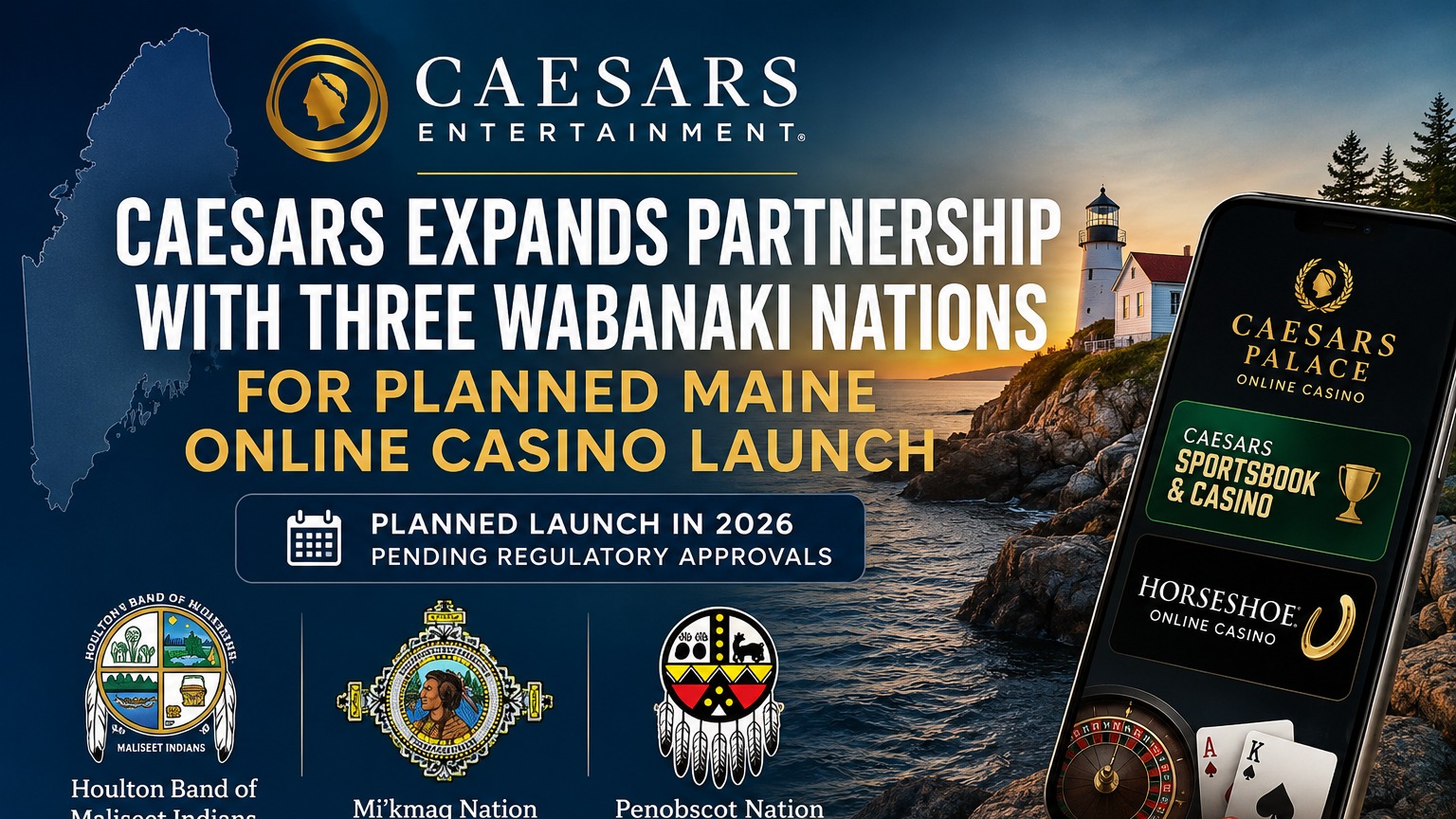
AUGUSTA, Maine — Caesars Entertainment said it has expanded its partnership with three Wabanaki Nations, positioning the casino and online gaming company for a planned online casino launch in Maine in 2026, pending regulatory approval.
The long-term agreement involves the Houlton Band of Maliseet Indians, the Mi’kmaq Nation and the Penobscot Nation, according to a Caesars Entertainment announcement issued June 24.
Under the expanded partnership, Caesars plans to bring three online casino brands to Maine: Caesars Palace Online Casino, Caesars Sportsbook & Casino and Horseshoe Online Casino. The company said each brand would offer a different digital casino experience for players if the launch receives the necessary approvals.
The announcement does not mean online casino gambling is live in Maine. Caesars said the potential launch remains subject to regulatory approvals, and Maine regulators are still moving through the rulemaking process for internet gaming.
Caesars Builds on Maine Sports Betting Partnership
The planned Maine online casino rollout would build on Caesars’ existing sports wagering relationship with the same three Wabanaki Nations. Caesars Sportsbook launched in Maine on mobile and desktop in November 2023 through its partnership with the Houlton Band of Maliseet Indians, the Mi’kmaq Nation and the Penobscot Nation.
Eric Hession, president of Caesars Digital, said in the company’s announcement that the expanded agreement reflects Caesars’ commitment to its tribal partners and to a localized digital gaming experience for Maine residents.
Caesars said its planned online casino platforms would include slot titles, table games and live dealer offerings, subject to approval. The company also said the Maine platforms would integrate with Caesars Sportsbook and use a single login and wallet through Caesars’ Universal Digital Wallet.
Eligible play would also connect to Caesars Rewards, the company’s loyalty program, allowing users to earn credits that may be redeemed across Caesars destinations and experiences.
Maine Online Casino Law Still Requires Licensing and Rules
The deal follows the enactment of LD 1164, “An Act to Create Economic Opportunity for the Wabanaki Nations Through Internet Gaming”, which became Public Law 2025, chapter 538, without the governor’s signature on Jan. 11, 2026.
A Maine Legislature enacted law summary says the law authorizes each federally recognized Indian nation, tribe or band in Maine to operate internet gaming pursuant to a license from the Gambling Control Unit within the Department of Public Safety. The summary also says only a federally recognized Indian nation, tribe or band in Maine is eligible to obtain a license and operate internet gaming.
The law defines internet gaming as approved card games, dice games and other games of chance offered through an approved mobile application or other digital platform. The statute lists games such as blackjack, poker, craps, roulette and baccarat, while excluding mobile sports wagering, fantasy contests, advance deposit wagering and land-based casino games regulated under other chapters.
The Maine Gambling Control Unit’s internet gaming rulemaking page lists a public hearing on proposed internet gaming rules for July 15, 2026, with written comments due July 27.
Proposed rules published by the Gambling Control Unit cover licensing, platform operators, suppliers, geolocation, cybersecurity, player accounts, responsible gaming controls and other compliance requirements. The proposed language says a patron must be at least 21 years old and physically present in Maine when placing a wager.
Tribal Leaders Frame Deal as Economic Development
Tribal leaders described the Caesars agreement as an economic development opportunity tied to sovereignty, local services and long-term self-sufficiency.
Penobscot Nation Chief Kirk Francis said the partnership builds on the sports wagering relationship and reflects the value of working with a partner that respects tribal sovereignty and understands tribal communities, according to Caesars.
Mi’kmaq Nation Chief Sheila McCormack said the move into online casino gaming would help create economic opportunities while keeping any future platform responsible and well regulated.
Houlton Band of Maliseet Indians Chief Clarissa Sabattis said internet gaming revenue could provide the tribal government with a more stable long-term source of funding for essential services and infrastructure.
Caesars said it will invest in local workforce development by employing, training and developing members of each nation. The company also said it will provide financial support for tribal community programs and initiatives.
State Revenue and Legal Challenge Remain Part of the Background
Maine’s internet gaming framework also includes state revenue distribution requirements. The Maine Gambling Control Unit’s revenue distribution page says operators must collect and distribute 18% of adjusted gross internet gaming receipts to the director, who forwards the money to the state treasurer.
The revenue is allocated among several state accounts, including Gambling Control Unit administrative expenses, gambling addiction prevention and treatment, dairy stabilization, opioid use disorder prevention and treatment, emergency housing, Maine Veterans’ Homes, the Fund for a Healthy Maine and school renovation.
The law also faces a federal legal challenge. The Native American Rights Fund said in April that the four Wabanaki Nations intervened in a lawsuit brought by Oxford Casino Hotel and others seeking to invalidate Maine’s internet gaming law on constitutional grounds.
Caesars’ June 24 announcement covers three Wabanaki Nations: the Houlton Band of Maliseet Indians, the Mi’kmaq Nation and the Penobscot Nation. The Passamaquoddy Tribe is not listed in the Caesars expanded agreement but is among the Wabanaki Nations involved in defending the internet gaming law, according to NARF.
For Caesars, the agreement creates a pathway to expand its digital casino business in Maine if regulators approve the launch. For the three Wabanaki Nations in the Caesars partnership, the agreement could create a new online gaming revenue stream under a state framework designed to support tribal economic development.
The planned launch remains pending as Maine completes its internet gaming rulemaking and regulatory approval process.
Responsible gaming: In Maine, players must be 21 or older to gamble. Anyone with a gambling problem can call 1-800-GAMBLER.
Sources
- Caesars Entertainment press release, June 24, 2026
- Caesars Sportsbook Maine launch announcement, Nov. 3, 2023
- Maine LD 1164 / Public Law 2025, chapter 538
- Maine Legislature enacted law summary for LD 1164
- Maine Gambling Control Unit internet gaming rulemaking
- Maine Gambling Control Unit internet gaming revenue distribution
- Native American Rights Fund update on Wabanaki Nations litigation