

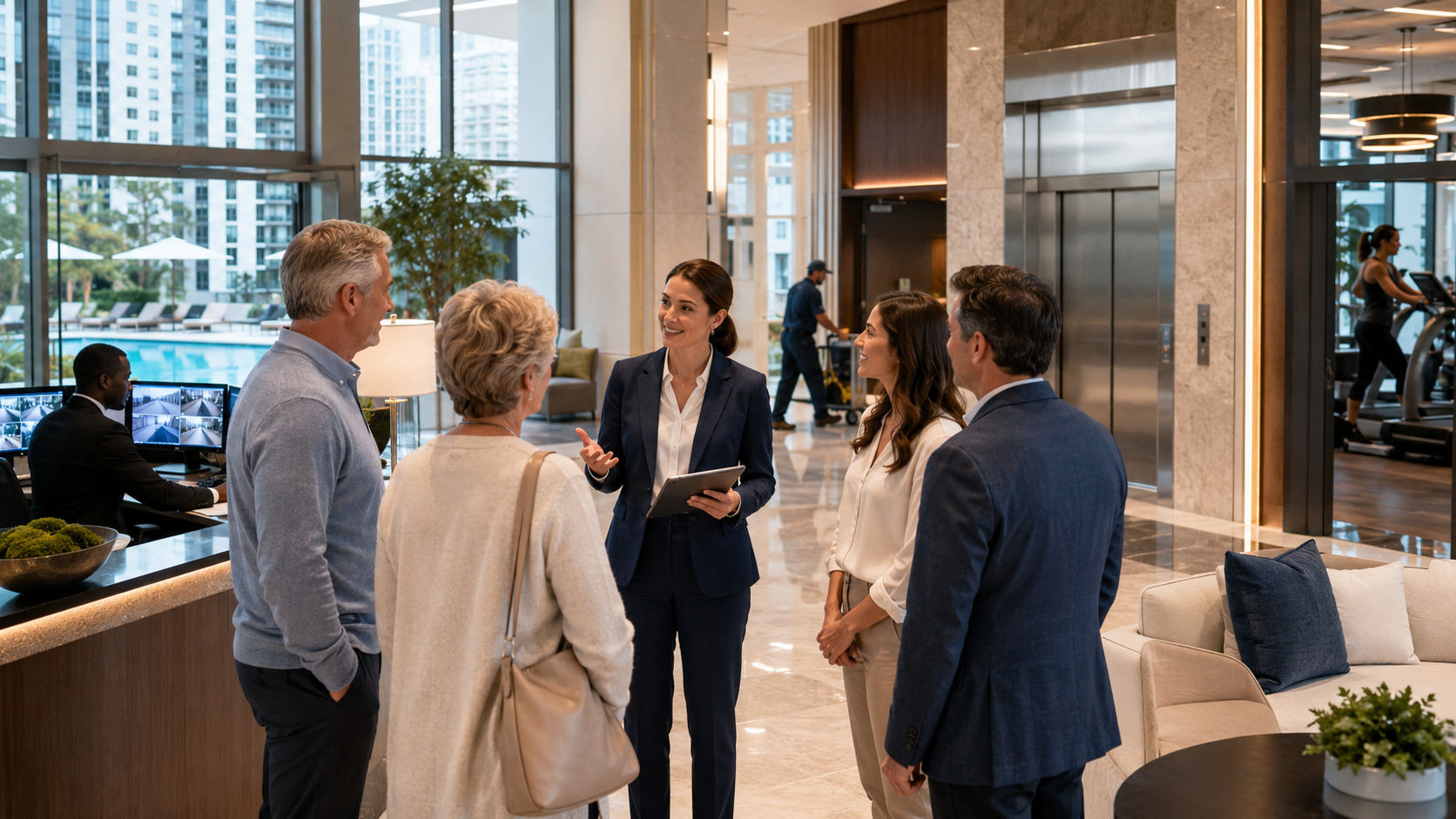
High-rise living can be extraordinary. Residents enjoy beautiful surroundings, shared amenities, enhanced security, professional services and the convenience of having many of life’s necessities managed within one community.
When everything is running well, the experience can feel effortless.
Of course, it is not effortless.
Behind every polished lobby, sparkling pool, functioning elevator, clean hallway and welcoming staff member is an operation that requires planning, funding, maintenance, supervision and cooperation. The more luxurious the property, the more complex that operation generally becomes.
As a community association manager, there are a few things I wish more homeowners and residents understood about what happens behind the scenes. The most important is also the simplest:
There should not be an “us and them.”
There is only we.
Your Manager Is Not the Enemy
A good community association manager is an advocate for the community.
The manager’s role is not to stand between residents and their enjoyment of the property. It is to help protect the property, maintain its value, support the board, oversee operations, communicate with residents and help the community function as successfully as possible.
That includes listening to concerns, solving problems, coordinating services and explaining processes that may not be obvious from the outside.
It also occasionally includes saying no.
A request may conflict with the governing documents, create an insurance or safety concern, require board approval, affect neighboring residents or involve a building system that is more complicated than it initially appears.
In a high-rise, a seemingly simple request can involve security, engineering, elevators, plumbing, fire and life-safety systems, insurance requirements, specialty contractors, permits or access to multiple homes.
Moving carefully is not always inaction. Sometimes it is the difference between solving one problem and creating five new ones.
A manager who cannot approve every request is not necessarily working against a resident. Sometimes saying “no,” “not yet” or “let us investigate this first” is part of protecting the resident and the community as a whole.
The Board Is Not a Separate Corporation
Homeowners sometimes speak about “the board” or “the HOA” as though these are outside organizations that have descended upon the property.
They are not.
The homeowners association is made up of the homeowners. The board is generally composed of homeowners elected by other homeowners to make decisions on behalf of the association.
Board members are usually unpaid volunteers. They give their time to budgets, contracts, reserve planning, homeowner concerns, legal matters, meetings, workshops and difficult decisions that may never satisfy everyone.
That does not mean every board member is automatically a saint.
Board service should not be pursued for power, prestige, personal advantage or the opportunity to settle old grievances. It should be entered into with a genuine desire to serve the community, exercise sound judgment and protect the association’s long-term interests.
Board members should be held accountable for their decisions and conduct. At the same time, it is worth recognizing that responsible board service can be time-consuming, demanding and remarkably thankless.
These volunteers are not employees of the residents, nor are they members of a distant corporate headquarters. They are neighbors who have accepted the responsibility of making decisions for a community in which they also own property.
When the Association Pays, the Community Pays
The same misunderstanding often appears when someone says, “I will sue the HOA.”
An association is a legal entity, so an owner is not literally filing a lawsuit against themselves. However, the association does not have a mysterious supply of money that belongs to no one.
Legal fees, insurance deductibles, increased premiums, settlements and other expenses may ultimately affect the association’s finances. Those finances are funded by the homeowners.
There are certainly circumstances in which an owner may need to assert legal rights. The point is not that residents should never challenge an association. It is that legal conflict within a community rarely occurs without cost to the community itself.
Whenever possible, begin by asking questions, requesting documents, speaking directly with management and allowing the association an opportunity to understand and address the concern.
A conversation is usually less expensive than litigation. It also tends to be considerably less exhausting.
Luxury Is Operational, Not Merely Decorative
Residents naturally want their community to look and feel luxurious.
They want the lobby to have a wow factor. They want the property to be clean, the landscaping maintained, the amenities available, the elevators functioning and the staff professional and responsive.
Those expectations are reasonable. They also come at a cost.
Luxury is not created simply by installing attractive finishes and declaring the work complete. It must be maintained every day.
Every amenity creates ongoing responsibilities. It must be cleaned, inspected, serviced, repaired, insured and eventually replaced. It may require staffing, security, utilities, supplies, specialized vendors or regulatory compliance.
A swimming pool is not simply a swimming pool. It is water treatment, inspections, equipment, furniture, cleaning, insurance, repairs and future replacement planning.
A fitness center requires maintenance, sanitation, equipment servicing and capital planning.
A valet operation requires staffing, supervision, training, insurance and accountability.
Elevators, access-control systems, gates, cameras, fire systems, plumbing systems, cooling systems and common-area finishes all require attention long before residents notice a visible problem.
The “wow factor” is not self-sustaining.
A community’s budget must account not only for today’s appearance and service level, but also for tomorrow’s repairs and replacements. Assessments are not simply fees paid for individual convenience. They fund the shared operation and long-term stability of the entire property.
A High-Rise Manager Must Know a Lot About a Lot
A community association manager is not expected to replace the engineer, attorney, accountant, insurance professional or contractor.
The manager must, however, know enough about many different subjects to recognize potential problems, ask informed questions, coordinate the appropriate experts and help the board make responsible decisions.
On any given day, a high-rise manager may be:
- Reviewing financial reports and contracts
- Coordinating repairs with engineers and vendors
- Supervising employees and contracted staff
- Walking the property to identify maintenance or appearance concerns
- Responding to resident questions
- Preparing for a board meeting
- Managing an emergency
- Reviewing insurance requirements
- Working with legal counsel
- Planning a community event
- Following a construction project
- Addressing a personnel issue
- Meeting with public officials or neighboring stakeholders
- Monitoring outside developments that could affect the property
- Researching new technology or changing laws
Sometimes all of that happens before lunch, which is why the manager may be carrying a radio, a phone, a folder and a slightly furrowed brow.
The more amenities and services a community offers, the more staff members, vendors, contracts, systems and expectations the manager must coordinate.
This is also why on-site management is particularly valuable in many high-rises and larger condominium communities. A manager who is regularly present can see the property, understand its rhythms, build relationships with residents and staff, and identify concerns before they become larger problems.
Community Association Management Is a Profession
In Nevada, becoming a fully qualified community association manager involves far more than taking a short class and printing business cards.
Applicants must complete approved education, pass an examination and satisfy the state’s certification requirements. Those who enter through provisional status must work under supervision for at least two years and complete 3,120 hours of active experience.
That experience is not limited to answering emails or attending meetings. It includes financial management, property and facilities management, association governance, insurance, legal and regulatory duties, and building a sense of community.
Once certified, managers must continue their education. State-mandated coursework is important, but strong managers also keep learning about evolving technology, building operations, insurance, employment practices, safety, hospitality trends and changes in the law.
The initial class is merely the front door. The 3,120 supervised hours are where the profession begins to introduce itself properly.
Like every profession, community association management has exceptional practitioners, average practitioners and a few people who may have chosen the wrong line of work.
Residents should expect competence, professionalism, accessibility, objectivity and ethical conduct from their manager. Managers should also be recognized as trained professionals whose work requires judgment, education, experience and a broad range of skills.
Talk With the Manager, Not Around the Manager
When a concern arises, the most productive first step is often the simplest: talk directly with management.
A good manager should be accessible, willing to listen and able to explain the process, even when the answer is not immediate or is not the answer the resident hoped to receive.
There is a meaningful difference between talking with the manager and talking at the manager.
There is also a difference between raising a concern with the person who may be able to resolve it and discussing it with every neighbor, staff member and board member before giving management an opportunity to help.
Residents do not need to agree with every decision. They should be able to ask reasonable questions and receive respectful, understandable answers.
In return, managers should be given the opportunity to gather information, consult the appropriate professionals and respond based on facts rather than pressure.
The fastest answer is not always the best answer, particularly when the issue involves safety, finances, governing documents or shared building systems.
Good Management Protects More Than the Building
For many homeowners, their residence may be the largest investment of their lives. For others, it may be one of several investments, but it is still a significant financial asset.
A well-managed association helps protect that investment.
Property values are influenced by more than the condition of an individual unit. Buyers, lenders and insurers may also consider the association’s finances, reserve funding, maintenance history, insurance, governance, appearance and overall operation.
Good management helps the board plan for long-term needs rather than merely reacting to the emergency of the day.
It also helps create something less easily measured but equally important: confidence.
Residents should be able to feel that someone is paying attention, that the property is being cared for, that concerns can be raised and that decisions are being made with the community’s future in mind.
We Are on the Same Side
The relationship between residents, the board and management will never be perfect. People will disagree. Requests will occasionally be denied. Repairs will sometimes take longer than anyone would prefer. Budgets will involve difficult choices.
But disagreement does not require division.
An association works best when homeowners, residents, board members, management, staff and vendors recognize that they have different roles but share an interest in the same outcome: a safe, financially sound, attractive and welcoming community where residents feel heard and their investments are protected.
The manager should not be the enemy.
The board should not be a remote ruling class.
The residents should not be treated as interruptions.
We are all part of the same community, and the most successful communities are built when we approach one another with questions before accusations, conversation before conflict and the understanding that maintaining a wonderful place to live is a shared responsibility.
There is no “us and them.” There is only the community we create together.
Contribute to Las Vegas News
Have expertise on an issue affecting Las Vegas?
Las Vegas News welcomes thoughtful guest contributions from professionals, community leaders, and subject-matter experts.
Submit a Guest Article