

 Las Vegas News6 followersVerified
Stay connected and personalize your Newswire experience.
How to Advertise Your Business as Digital Ad Spending Soars
- Publisher
- Las Vegas News
- Topic
- Guides
- Location
- Las Vegas, NV, US
- Published
- Oct 16, 2026 · 8:13 PM
Las Vegas Newswire preserves the publisher's attribution and original-source link while adding publisher, topic and related-coverage navigation for readers.
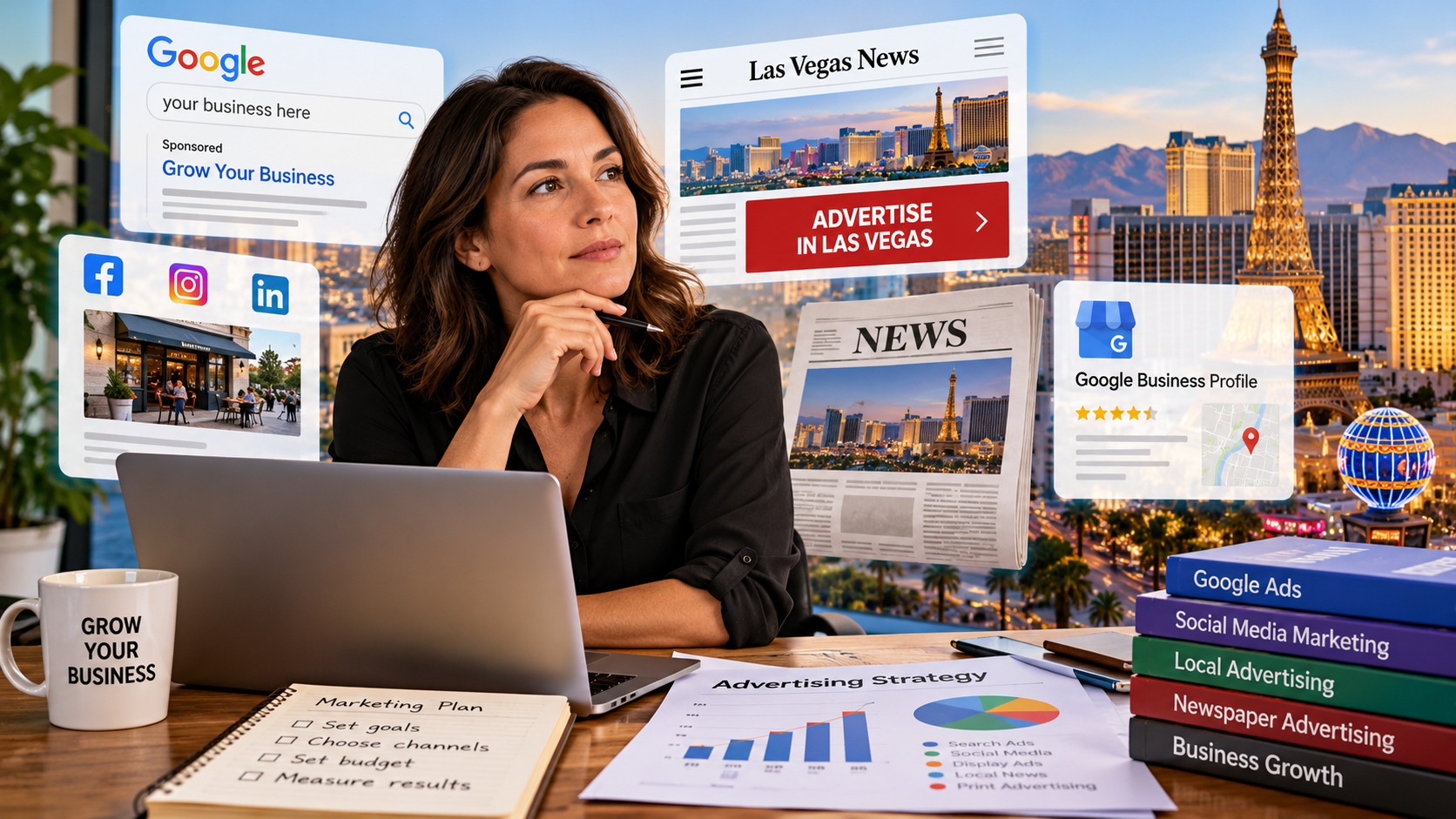
U.S. digital advertising revenue reached nearly $295 billion in 2025. For smaller companies, the harder question is not where ads can appear, but which investments actually bring in customers.
By: Prince Adeyemi — Editor-in-Chief, Las Vegas News · Oct. 16, 2026 · Business analysisLAS VEGAS — American businesses are spending record amounts on digital advertising, but the expanding marketplace makes it hard for smaller companies to decide how much to spend to attract a customer and how they can tell whether the money worked.
U.S. internet advertising revenue rose to $294.6 billion in 2025, up 13.9% from a year earlier, according to an April 2026 report from the Interactive Advertising Bureau, prepared by PwC. The figures describe industry revenue, not the return individual businesses receive from advertising.
Search engines, social networks, video platforms and news publishers now compete for business advertising budgets. Each promises a different way to reach potential customers. The challenge is determining whether the people who see or click an ad are likely to buy.
The central question: An advertisement can generate thousands of impressions and still fail to pay for itself. Business owners need to measure the cost of acquiring customers, not merely the cost of attracting attention.How to advertise your business starts with knowing the customer
Before buying advertising, businesses need to identify where customers live, what they need, and what action would count as success. The U.S. Small Business Administration recommends market research and competitive analysis to understand demand, market size, and competing businesses.
For a neighborhood restaurant, success might mean more reservations. A law firm may prioritize qualified consultations. A ticket seller may need purchases before an event date. An online retailer may seek profitable orders across several states.
Those goals require different campaigns. An advertisement that builds recognition among thousands of readers is not necessarily a substitute for one that reaches a person ready to book an appointment.
Search ads can capture demand — at a price
Google Ads and Microsoft Advertising allow businesses to advertise alongside relevant searches. The attraction is timing: Someone looking for a particular service may already be considering a purchase.
Search campaigns commonly charge per click, but the price depends on competition, the query, bidding, and other auction factors. A high-priced keyword is not automatically a profitable one.
Google also cautions that an average daily campaign budget is not a strict daily spending cap. For most campaigns, spending on a particular day may reach twice the average daily budget, subject to the applicable monthly limit.
| Illustrative campaign | Calculation | Result |
|---|---|---|
| Advertising spend | 100 clicks × $5 per click | $500 |
| New customers | 5 customers from 100 clicks | 5% click-to-customer rate |
| Acquisition cost | $500 ÷ 5 customers | $100 per customer |
That $100 cost could be sensible for a business with strong customer margins or repeat purchases. It could be disastrous for one earning only $30 from each new sale. The example is hypothetical; actual results vary.
Social media can build awareness, but engagement is not a sale
Social platforms offer opportunities to reach people who are not actively searching for a business. That can be valuable for new products, restaurants, entertainment, retail promotions and events.
But an impression, video view or reaction is not equivalent to a customer. Businesses should distinguish campaign reach from visits, qualified inquiries and completed transactions. A popular post may generate attention without covering its advertising cost.
The measurement challenge becomes more complicated when consumers encounter a business through several channels before buying. Businesses should avoid attributing every sale to whichever advertisement received the final click.
Local advertising no longer requires a local office
A company in California may want customers in Las Vegas. A convention vendor may need to reach people traveling to Nevada. A regional service provider may operate across multiple cities. These businesses can consider geographic targeting through advertising platforms or placements in publications serving the market.
However, targeting people in a city is not necessarily the same as targeting people interested in that city. Businesses should review location settings, audience definitions and publisher readership data before buying.
Las Vegas presents a particularly mixed market of residents, workers, visitors and event attendees. For more detail on how advertisers compare local media, billboards and digital options, see Las Vegas News’ existing examination of advertising in the city.
Newspaper advertising has moved beyond the printed page
Newspaper advertising may mean a print placement, a digital banner, a newsletter sponsorship or another publisher product. The formats differ in how audiences encounter them and what performance data buyers can obtain.
Before purchasing any placement, advertisers should ask where it will appear, whom it is expected to reach, how long it will run, whether reporting is available and what happens if a campaign must be changed.
| Advertising method | Potential strength | Question to ask |
|---|---|---|
| Search advertising | Reaches people expressing intent | What does a qualified customer cost? |
| Social media advertising | Introduces offers to audiences | Are interactions leading to sales? |
| Local news display | Reaches readers of a defined publication | What audience and placements are included? |
| Print advertising | Reaches readers of a physical publication | How will response be measured? |
| Email marketing | Communicates with an existing audience | Are permissions and list quality sound? |
Free business listings are not the same as paid advertising
Some businesses can establish an online presence without buying ads. For eligible businesses, a Google Business Profile is free and helps manage business information on Search and Maps. It is separate from Google Ads, Google’s paid advertising service.
That distinction matters because searches for “Google My Business advertising” can refer to two different needs: appearing in local search results and paying for additional exposure. Businesses should understand the difference before committing money.
A separate article in this series will examine how to advertise a business on Google, including free profiles, paid search, budgets and alternatives. [Editor’s production note: Add the actual Article 2 permalink here after publication; do not use a placeholder URL.]
How much should a small business spend on advertising?
No universal percentage of revenue works for every business. An advertiser can begin with a test budget tied to the economics of its product, the expected value of a customer and the amount of uncertainty it can tolerate.
Consider a hypothetical business with a $200 contribution margin per new customer before advertising. If a $600 campaign produces six attributable customers, the acquisition cost is $100 each. If it produces only two, the cost rises to $300 each — more than the assumed contribution margin.
The difference is not the number of impressions served. It is how many customers the business acquired and what those customers were worth.
Advertising claims can create legal risks
Campaign performance is only one part of the equation. The Federal Trade Commission says advertising must be truthful, not misleading or unfair, and supported by evidence. Those requirements extend to claims about products, prices and results.
Testimonials, endorsements and offers should also be presented accurately. An advertisement that produces short-term sales through unsupported claims can expose a business to regulatory action and damage customer trust.
The best advertising strategy is the one a business can measure
Businesses do not need to advertise on every platform. They need to know what each campaign is intended to accomplish, how results will be measured and when to stop spending on approaches that are not working.
Search may help capture existing demand. Social media can introduce an offer. News publishers can provide access to their readership. Email can help maintain relationships with existing customers. Each option has advantages and limitations.
The record growth in digital advertising revenue shows how much money is flowing through the market. It does not settle the decision facing an individual business owner. That decision still comes down to audience, cost, credible measurement and whether advertising contributes to sustainable customer growth.
Continue the seriesGoogle Business Profile or Google Ads? Why the difference matters
Many business owners want to advertise on Google, but free business listings, paid search placements and campaign budgets are not interchangeable. The next report examines what businesses need to know before paying for Google advertising.
Article 2 link will be added once its publication URL is confirmed.
Sources and methodology- IAB and PwC, 2025 Internet Advertising Revenue Report, released April 16, 2026.
- U.S. Small Business Administration, Plan Your Business.
- Google Ads Help, Manage Your Spend.
- Google Business Profile, product and pricing information.
- Federal Trade Commission, Advertising FAQs: A Guide for Small Business.
Financial examples are illustrative, not typical advertising outcomes. This article is general business reporting and does not recommend any particular paid advertising provider.
Article at a Glance
- Publisher
- Las Vegas News
- Author
- Prince Adeyemi
- Primary topic
- Guides
- Coverage
- Las Vegas, NV, US
- Published
- Oct 16, 2026 · 8:13 PM
About the Publisher
Powered by Las Vegas Newspaper
Coverage
This report is associated with Las Vegas, NV, US based on the location metadata supplied with the story or publisher profile.
Topics & Keywords
Primary topic: Guides
Related topics: Guides, Las Vegas, NV, Local News
Frequently Asked Questions
Who published this report?
This report was published by Las Vegas News and credits Prince Adeyemi as the author.
What is the primary topic?
The story is categorized as Guides in the Newswire metadata.
What area does this story cover?
The available Newswire metadata associates this report with Las Vegas, NV, US.
What do you think about this story?
Share your perspective and join the conversation with other readers.
Discussion is hosted by Las Vegas Newswire. Publisher attribution and the originating report remain unchanged.
About Las Vegas News Publisher Network
Las Vegas News Publisher Network is the publisher-distribution network operated by Las Vegas News. It organizes reporting from participating publishers while preserving publisher attribution and links to the original source.
Las Vegas News6 followersVerified Stay connected and personalize your Newswire experience.
Loading recommendations…