
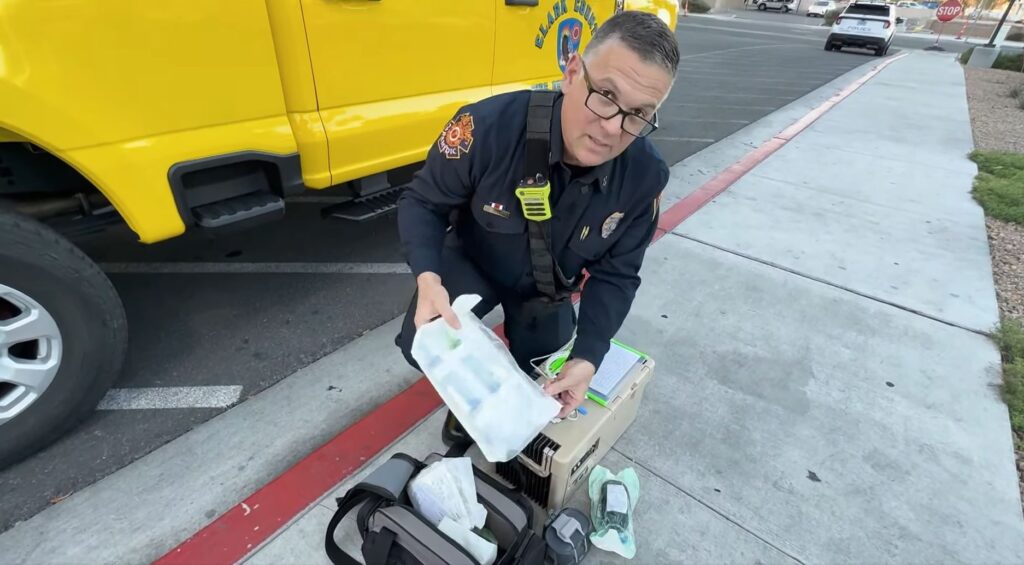
CLARK COUNTY, Nev. — The Clark County Fire Department has launched a first-of-its-kind emergency medical program in Nevada, equipping its EMS-18 response vehicle with whole blood to treat patients suffering from severe hemorrhaging in the field.
The initiative makes EMS-18 the first fire apparatus in the state to carry whole blood, a critical advancement in trauma care. Hemorrhaging is one of the leading causes of preventable death in traumatic injuries, and rapid access to whole blood before hospital arrival significantly improves survival outcomes.
Clark County Fire Department officials said the program was developed in partnership with University Medical Center of Southern Nevada, Vitalant Nevada, the Southern Nevada Health District, and the Clark County Firefighters Local 1908 EMS Committee. The effort is operating as an approved Southern Nevada Health District protocol trial, with the long-term goal of expanding whole blood distribution across the Las Vegas Valley.
Medical research cited by officials shows the risk of death increases by approximately 11% for every minute a blood transfusion is delayed. Studies also estimate that administering whole blood can reduce mortality risk by up to 37% in trauma patients experiencing severe blood loss.
Under the protocol, Clark County Fire Department EMS captains are authorized to administer whole blood products in the field. They completed specialized training on blood administration, transportation, and storage provided by the University Medical Center laboratory team and the department’s EMS Training Division.
The EMS-18 vehicle has been specially modified to support the program. It is equipped with a refrigerated cooler designed specifically for blood storage, powered by an independent electrical system with an additional backup battery to ensure temperature stability and product safety at all times.
To prevent waste of this critical resource, the program includes a rotation protocol. If a unit of blood carried on EMS-18 approaches its expiration date, it is exchanged for a fresh unit from the UMC laboratory. The near-expiration blood is then prioritized for immediate use by UMC Trauma services, ensuring no viable blood product is discarded.
Officials said the pilot program represents a major step forward in prehospital trauma care and could serve as a model for other emergency medical services across Nevada if expanded valleywide.