



Human trafficking in Las Vegas continues to escalate as rising arrests by law enforcement collide with shrinking resources for nonprofit organizations tasked with supporting survivors. Driven by the city’s tourism economy, nightlife industry, and growing homelessness crisis, trafficking cases increasingly involve sexual exploitation and vulnerable youth, placing added strain on police, hospitals, and advocacy groups across Southern Nevada.
Las Vegas remains one of the nation’s most active hubs for human trafficking, driven by high tourism volume, a 24-hour nightlife economy and persistent social vulnerabilities. New data and operational trends from 2024–2025 show that while law enforcement efforts have intensified and arrests are rising, nonprofit service providers are facing mounting pressure as demand outpaces available resources.
Help other readers find trusted local news
A short review helps Las Vegas readers discover fact-based reporting and supports independent local journalism.
A Persistent Risk Environment
Known globally as the “Entertainment Capital of the World,” Las Vegas presents unique challenges in combating human trafficking. Sexual exploitation remains the most prevalent form, though labor trafficking continues to surface in service-sector jobs and among unhoused populations. Experts note that the same factors fueling the city’s economic success—tourism, conventions, and nightlife—also create environments traffickers exploit to conceal coercion and movement of victims.
Law Enforcement Operations and Arrest Trends
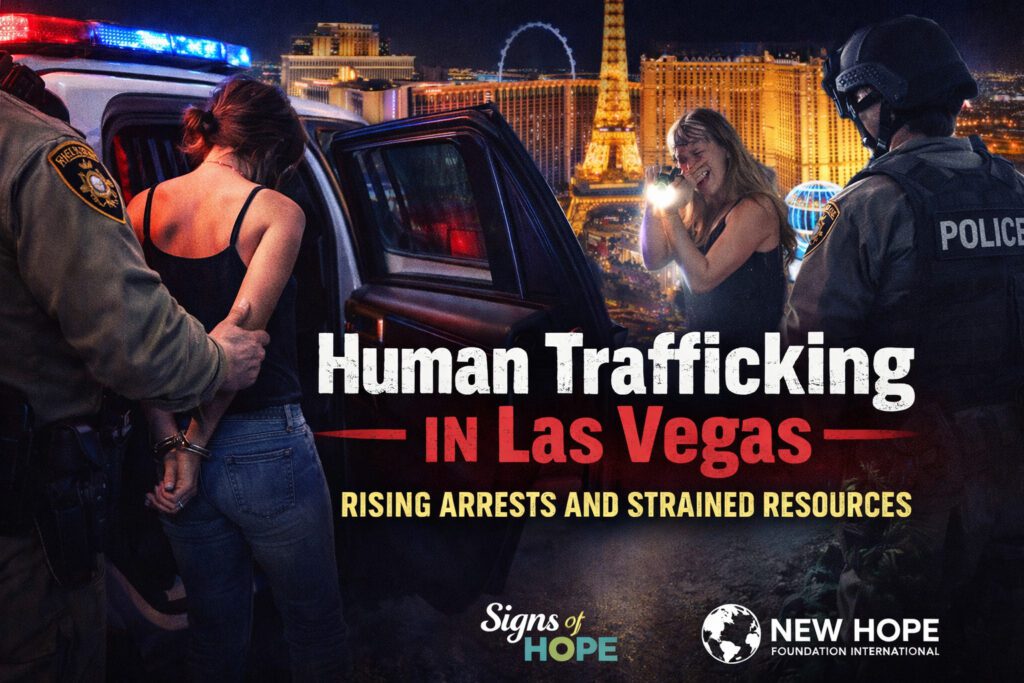
Recent multi-agency operations led by the Las Vegas Metropolitan Police Department reflect a sharpened focus on traffickers and buyers rather than victims. Coordinated efforts with North Las Vegas and Henderson police, the Nevada Attorney General’s Office, the FBI, and Homeland Security Investigations resulted in 115 arrests during major enforcement actions in late 2025—an increase of roughly 11% from the prior year.
Notably, arrests for pandering rose by 133%, signaling a strategic shift toward dismantling trafficking networks and disrupting recruitment pipelines. Undercover operations, including the use of covert female detectives, continue to prove effective in identifying traffickers operating within commercial sex markets.
Victim-Centered Policing Model
Authorities emphasize that enforcement is paired with immediate victim support. During operations, potential victims are offered crisis intervention, emergency housing, transportation, and access to social services. This model prioritizes safety and recovery over criminalization, aiming to break cycles of exploitation rather than perpetuate them.
Nonprofits on the Front Lines
Local nonprofits remain essential to Las Vegas’ anti-trafficking response, but many report growing strain. Signs of HOPE documented a 20% increase in trafficking victims encountered in 2024, including a 19.6% rise in juvenile survivors. At University Medical Center, services for sexual assault survivors increased by 24% over the same period.
At the same time, funding challenges—particularly reductions in federal Victims of Crime Act (VOCA) grants—have led to a reported 65% decrease in available counseling sessions. Advocates warn that reduced access to trauma-informed care risks leaving survivors without long-term stabilization support.
Among organizations working to close these gaps is New Hope Foundation International, which focuses on prevention, awareness, and direct support for vulnerable individuals. The organization also works at the intersection of homelessness, connectivity, and exploitation risk, helping individuals access critical resources and assistance.
Who Is Most at Risk?
Data and outreach efforts consistently identify several high-risk groups:
- Homeless and runaway youth, often targeted due to lack of stable housing and social protection
- Individuals involved in commercial sex, where coercion is frequently hidden behind apparent consent
- Tourists and transient populations, exploited through anonymity and rapid movement
The overlap between prostitution-related arrests and trafficking investigations underscores how traffickers leverage existing underground economies to mask exploitation.
What the Trends Show
- Arrests: Up 11% overall; pandering arrests increased 133%
- Victim encounters: Up 20%, with significant growth among juveniles
- Service capacity: Counseling services down 65% due to funding constraints
- Enforcement approach: Multi-agency, victim-centered, and intelligence-led
Why It Matters
Advocates and officials agree that rising trafficking indicators, combined with shrinking nonprofit resources, present a critical inflection point for Southern Nevada. Sustained funding, coordinated enforcement, and expanded social services—particularly for youth and unhoused populations—are widely seen as essential to preventing further growth in exploitation.
Where to Get Help
- RISE Advocate Hotline: 702-936-4004
- National Human Trafficking Hotline: 1-888-373-7888
- Local support: Signs of HOPE; New Hope Foundation International
The Bottom Line
Human trafficking in Las Vegas is not a hidden problem—it is an evolving challenge shaped by tourism, homelessness, and organized exploitation networks. While arrests and enforcement efforts are increasing, long-term progress depends on sustained investment in survivor services and prevention. As nonprofits and law enforcement continue to adapt, community awareness and support remain critical in addressing one of the region’s most complex public safety issues.












Leave a Reply