


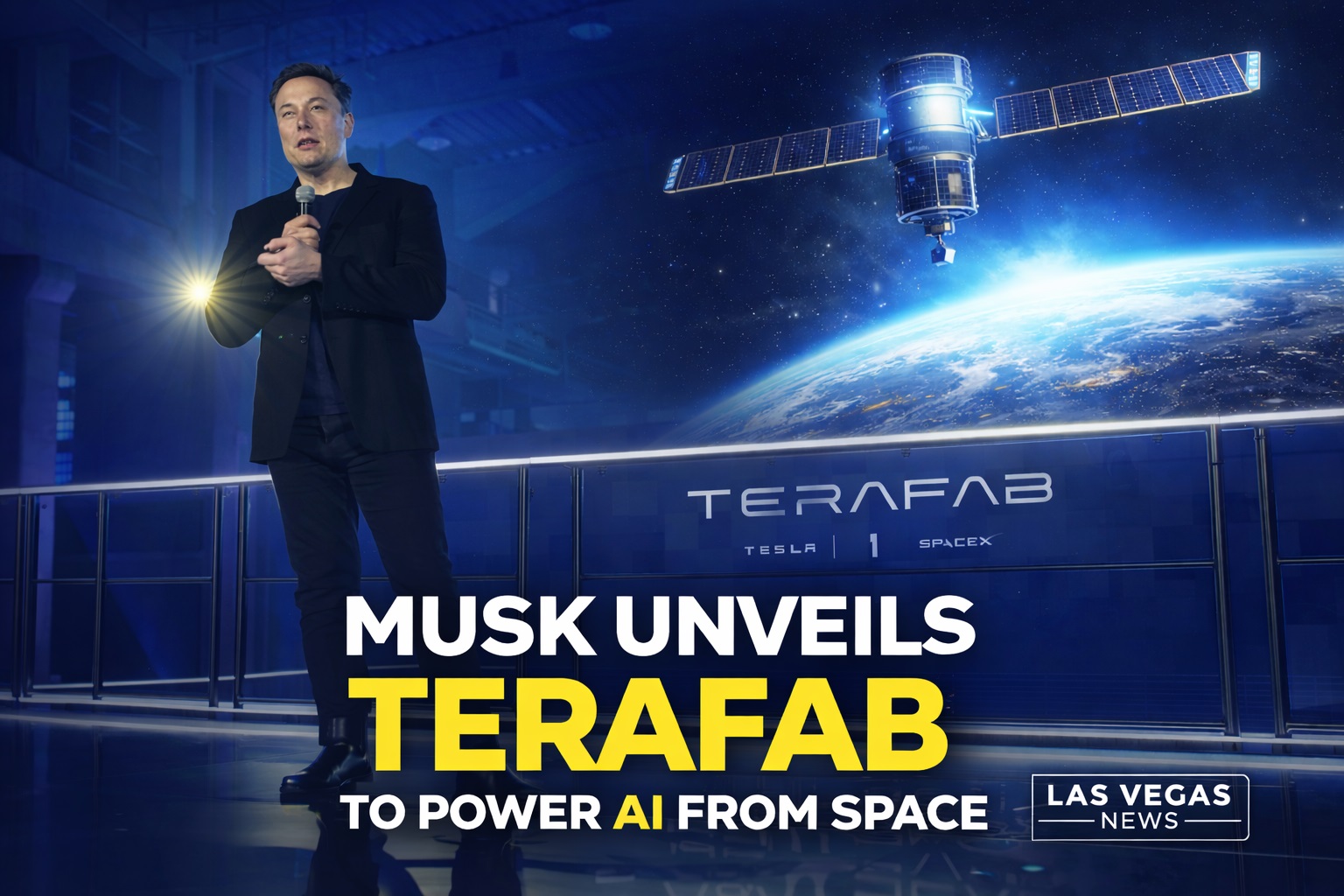
LAS VEGAS (Las Vegas News) — Elon Musk on Saturday revealed Terafab, a sweeping initiative involving SpaceX, Tesla and xAI that aims to dramatically expand global artificial intelligence computing capacity — including moving large portions of it into space.
The plan centers on building a next-generation semiconductor fabrication system capable of producing terawatt-scale computing power annually, far exceeding today’s global AI chip output, alongside a network of solar-powered satellites designed to run compute workloads in orbit.
Help other readers find trusted local news
A short review helps Las Vegas readers discover fact-based reporting and supports independent local journalism.
Musk argued that current infrastructure on Earth cannot support the scale of computing required for future AI systems, pointing to both supply chain limitations and energy constraints.
A new kind of chip factory
At the core of Terafab is a vertically integrated manufacturing system designed to accelerate chip production.
Unlike traditional semiconductor supply chains, which are distributed across multiple companies and regions, Terafab would consolidate design, fabrication, testing and iteration into a single, tightly optimized process.
Musk said this approach is necessary because global chip production is not scaling fast enough to meet demand from rapidly advancing AI systems, robotics and autonomous technologies.
Two types of AI chips
The project outlines two primary chip categories.
The first focuses on edge inference, supporting real-time processing in Tesla’s autonomous vehicles, robotics platforms and future AI-powered systems. Demand for these chips is expected to surge as humanoid robots and autonomous fleets expand.
The second category is engineered specifically for space environments, designed to withstand radiation and operate efficiently under extreme thermal conditions. These chips would power orbital AI systems where traditional cooling and energy limitations are less restrictive.
Why Musk wants to move AI into space
A central argument behind Terafab is that Earth’s energy limits are becoming a bottleneck for AI growth.
Musk said deploying terawatt-scale computing on Earth would strain existing power infrastructure, while space offers direct access to abundant solar energy.
Instead of relying solely on terrestrial data centers, Terafab proposes building a network of solar-powered AI satellites capable of generating and using energy in orbit. Early systems would produce kilowatts of power, with future iterations scaling to megawatts and beyond.
Musk argued that capturing even a small fraction of solar energy in space could unlock dramatically larger compute capacity than is possible on Earth.
Starship’s role in scaling the system
The initiative depends heavily on Starship to transport infrastructure into orbit.
Reusable launch systems are key to making space-based computing economically viable. Musk pointed to ongoing improvements in payload capacity and launch costs as critical factors in scaling Terafab’s orbital network.
He also referenced longer-term concepts such as in-space manufacturing and off-world resource utilization to further reduce costs and expand capabilities.
Why this matters now
The Terafab announcement comes at a time when demand for AI computing is accelerating rapidly.
Advances in generative AI, autonomous systems and robotics are driving unprecedented need for processing power, while existing semiconductor supply chains and energy systems struggle to keep pace.
Musk’s proposal directly targets those constraints:
- Compute bottleneck: Global chip production is not scaling fast enough
- Energy bottleneck: Data centers require massive, growing power consumption
- Infrastructure bottleneck: Centralized systems limit expansion speed
By combining a new manufacturing model with space-based energy and compute, Terafab attempts to address all three simultaneously.
A long-term vision beyond Earth
Musk framed the project as part of a broader push to expand human civilization beyond Earth.
He said scaling computing power is essential not only for AI development, but also for enabling technologies that support long-term space exploration and industrialization.
Terafab, he suggested, represents an early step toward harnessing space-based energy at scale — a capability that could redefine both computing and human expansion into the solar system.
What comes next
Development timelines were not fully detailed, but Musk indicated that work on the manufacturing system and supporting infrastructure could begin in the near term.
The project faces significant challenges, including engineering complexity, cost, and the logistics of deploying large-scale orbital systems. Still, if successful, Terafab could reshape how computing infrastructure is built — shifting it from Earth-bound data centers to a hybrid system spanning both planet and orbit.
For now, the initiative stands as one of the most ambitious attempts yet to merge artificial intelligence, advanced manufacturing and space infrastructure into a unified platform designed for exponential growth.